NVIDIA Kumo Relational: Pre-Trained Foundation Model Beats Supervised ML
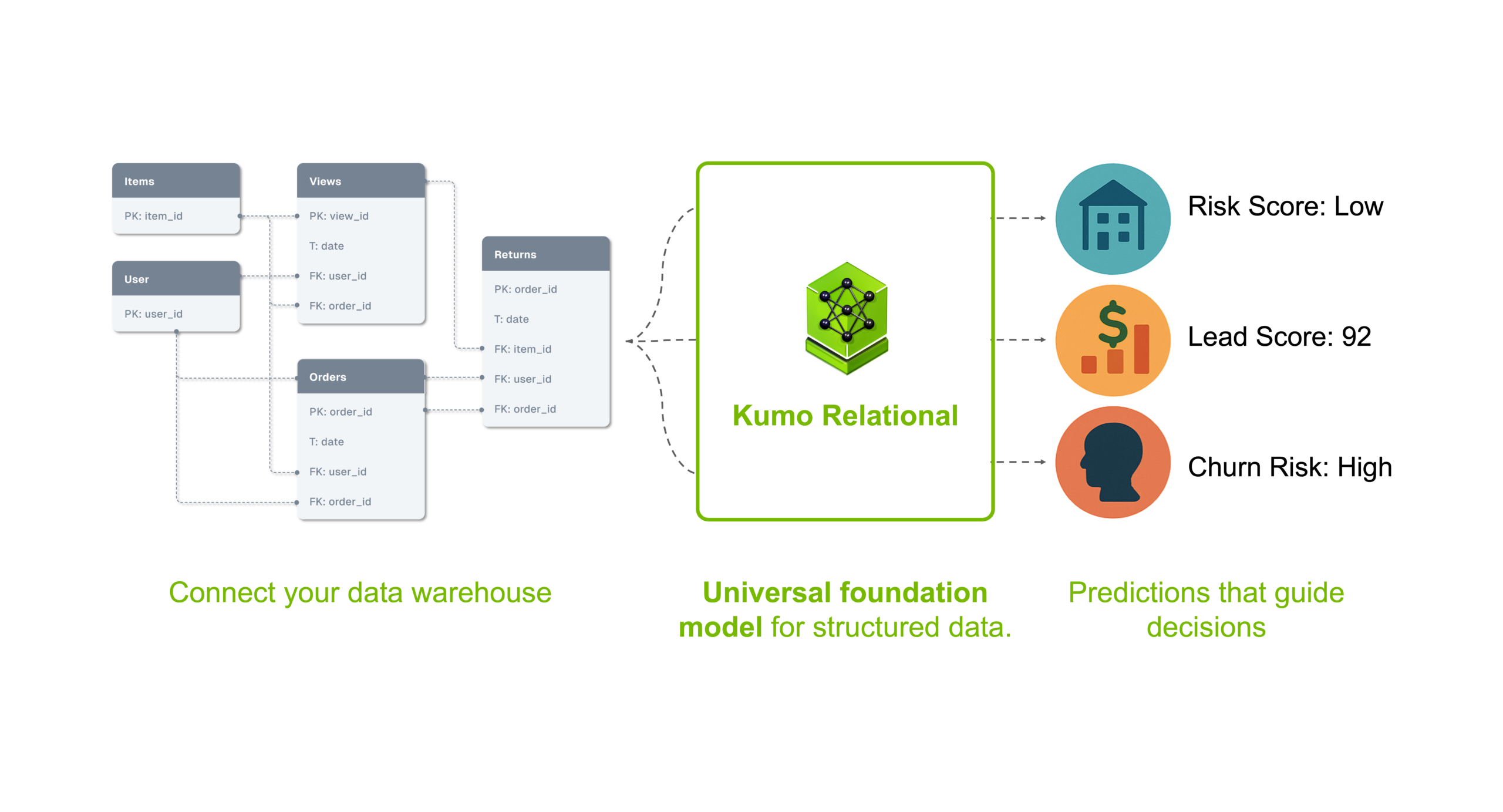
NVIDIA introduces Kumo Relational, a pre-trained relational foundation model that makes predictions directly on enterprise databases without task-specific training, feature engineering, or table flattening. Given a predictive query, it gathers up to 10,000 historical examples as context and produces outcomes such as churn, demand, or fraud in a single forward pass. According to the paper, it is the first few-shot foundation model to outperform supervised machine learning on common relational benchmarks: across 41 tasks on 15 databases, it beats supervised relational deep learning models and expert-engineered gradient-boosted tree pipelines, and on the SAP SALT enterprise benchmark it surpasses AutoGluon ensembles by 8% in mean reciprocal rank (MRR). It scales to databases with over 500 billion rows and is available through NVIDIA’s open-source, GPU-native structured-data-models library or as an NVIDIA NIM.
The work extends the standard foundation-model argument to structured data: one pre-trained model can be more accurate than task-specific pipelines, simpler to productionize, and flexible enough for agentic applications. On RelBench V1 classification tasks, Kumo Relational outperforms gradient-boosted trees on expert-engineered features by nearly 4 AUROC points on average. On SAP SALT, it beats XGBoost on engineered features by 7 MRR points out of the box and by 13 points after fine-tuning. A new prediction becomes a query instead of a project, and the Predictive Query Language gives agents a simple interface for asking predictive questions.
Unlike flat-table structured-data models, Kumo Relational operates directly on the database, respecting tables, foreign keys, and timestamps. It is pre-trained once on synthetic relational data and adapts to each new task through in-context learning. At inference, each context example pairs an entity-centric local subgraph at a point in time with its ground-truth target. Predictions involve three steps: automatic context generation, reasoning within tables, and reasoning across tables. For temporal tasks, the model replays historical database states, samples subgraphs up to an anchor timestamp, computes targets from later events, and serves the model only data from before the anchor to prevent leakage. Within tables, a lightweight network alternates column attention and row attention to filter noise. Across tables, a larger network distributes row embeddings through graph attention over primary-key/foreign-key relationships and cross-sample attention across context examples, avoiding quadratic cost by operating on row embeddings rather than every cell.
Pre-training uses entirely synthetic relational data generated with an approach based on PluRel (Kothapalli et al., ICML 2026), which extends single-table generators to full databases in three stages: schema generation, foreign-key links that cluster like real data, and column values from Structural Causal Models with temporal trends and cross-table dependencies. The resulting data is lightweight and effectively unlimited; PluRel reports that pre-training loss follows a power law as synthetic databases are added, with gains carrying over to real databases. Kumo Relational can also be fine-tuned on a specific dataset and task when maximum accuracy matters.
Evaluation covered 41 benchmarks across 15 relational databases from RelBench V1 and V2, SAP SALT, and 4DBInfer, spanning e-commerce, medical, enterprise, social, and academic domains; none were seen in pre-training. On the RelArena-α leaderboard, Kumo Relational sits on the accuracy-efficiency Pareto front out of the box at about 17 seconds median inference time per 1,000 samples and Elo 1,842, while the highest-scoring entry rt-plurel reaches Elo 1,878 at about 7,300 seconds, roughly 430 times slower. On SAP SALT, it surpasses large AutoGluon ensembles by 8% MRR and recent tabular foundation models by about 25%, and fine-tuning extends the AutoGluon lead to 16%. It performs well with as little as 0.2% of training data as context, stays stable when up to 75% of foreign-key links are removed, and barely degrades when many noisy columns are added. The authors state clear limits: it works best with meaningful relationships and temporal dynamics; task-specific supervised models may still win on very large training sets because in-context benchmarks used at most 10,000 examples; and predictive signals are expected to be reachable within a limited number of hops, so queries should start focused and expand as needed.
The model runs natively over databases in memory, through database and warehouse connectors, or through a custom graph engine that handles over 500 billion rows via memory-mapped I/O at up to 5 GB/s. It is included in the newly released structured-data-models library, the same library that powers the sister model Kumo Tabular, and it downloads weights from the Hugging Face Hub on first use. It can also be deployed as an NVIDIA NIM service with the structured-data-models-client, where predictions are written in Predictive Query Language. Code is released under Apache 2.0 and model weights under the OpenMDW License Agreement, version 1.1.


