Microduck Obstacle Avoidance: Sim2Real Workflow with Isaac Lab and Newton
Microduck‘s walking policy keeps the robot balanced but does not know how to steer around an obstacle in its path. This workflow adds local obstacle avoidance without retraining that walker: the walking policy’s weights stay fixed, and a separate navigation controller uses time-of-flight (ToF) sensing to adjust gamepad velocity commands before they reach the walking policy. Simulation and training are built on NVIDIA Isaac Lab, with Newton providing physics and depth measurement; deployment runs the navigation model on a laptop and sends adjusted commands to the walking policy on the robot.
For simulation you need a Linux system with a compatible NVIDIA GPU and driver, Git with Git LFS, and the uv package manager. For hardware testing you need a configured Microduck, the same backlash walking-policy export used by the navigation task, a supported ToF sensor with recorded configuration, a paired gamepad, and a level test area with obstacles. After cloning the exp/microduck branch of the Isaac Lab repository and running uv sync –frozen, you download and export the upstream backlash walking checkpoint once; the obstacle-avoidance task loads that export automatically.
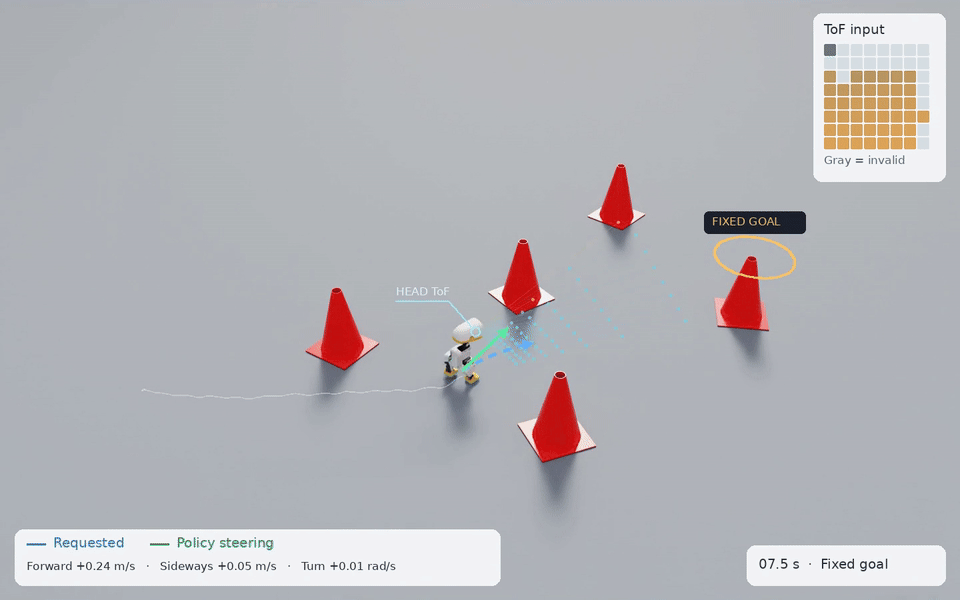
The environment combines simple primitives with OpenUSD assets from SimReady Central on Hugging Face: a cardboard box, office bin, bedside cabinet, and cones. At each episode reset it samples a layout, shuffles props, and varies their placement and rotation. Most courses scatter obstacles ahead of the duck, with a smaller mix of clear paths, barriers, and passages; layouts are mirrored and mix aligned and staggered rows. Goals start ahead, and the movement command guides the duck toward them while the policy adjusts the command around obstacles.
The IsaacContrib-ObstacleAvoidance-Flat-MicroDuck task separates obstacle avoidance from balance. The navigation policy uses ToF sensing to adjust forward, lateral, and yaw commands at 50 Hz, and the frozen walking policy converts those into joint actions. During training the actor receives ToF history plus body and controller state that is available on the real robot; the critic has extra simulation state but is not needed for deployment. Rewards encourage progress toward the goal, safe arrivals, and movement around obstacles, with credit only when the robot makes progress with sufficient clearance; penalties discourage fast approaches, abrupt command changes, collisions, and falls.
ToF is modeled by MicroDuckToFCamera, which extends Newton‘s LegacyMultiMeshRayCasterCamera to represent the VL53L5CX: an 8×8 grid at 15 Hz with a 45-degree field of view and a 0.12-4 m range, mounted on the duck’s head. Real recordings informed the simulated sensor placement and floor readings. Training adds noise, delays, and missing measurements, including near the grid edges, so the policy sees imperfect data.
Training runs PPO across 16,384 parallel environments for 1,500 iterations, with actor, critic, normalizers, and optimizer starting fresh. The task configuration loads the fixed walking checkpoint, robot model, and obstacle assets. The environment count is configurable rather than a minimum: lowering –num_envs fits smaller GPU memory but may require more training iterations and time. The article also reports a smaller-scale run on NVIDIA DGX Spark of about 6 hours with 4,096 environments and 3,000 PPO updates.
Playback evaluates the policy with the same props, frozen walker, and sensor randomization but a different seed. Checkpoints are stored under logs/rsl_rl/microduck_obstacle_avoidance_tof_flat_backlash/. Playing a checkpoint opens the Newton viewer and can record 20 seconds; set –viz none for headless recording. Playback exports TorchScript and ONNX models in the checkpoint’s exported folder, and the ONNX data file must be kept alongside the model.
Real-robot deployment uses the same walking policy that was used during navigation training. After loading that walker via Pollen’s policy-loading guide, you set up SSH access and run nav_pad.py in dry-run mode with the robot upright and still; dry-run copies helpers and streams sensor data but sends no movement commands. Once the proposed commands look correct, supervised navigation starts, with the stick held forward to request movement while the policy adjusts commands to avoid obstacles. Releasing the stick stops, X toggles navigation, and Ctrl-C ends the session. Forward speed is capped at 0.15 m/s by default, with an additional close-obstacle brake and stale-input stopping; the tutorial advises starting in a clear area and verifying stopping before testing a course.
The Microduck task collection includes velocity tracking on flat and rough terrain, stand-up recovery, sit-stand transitions, walking with fall recovery, ball kicking, ground picking, forward rolls, and roller-skating motions. The suggested next step is to build on the first Microduck tutorial, explore behaviors by changing commands, rewards, or environments, and evaluate policies on scenes outside the training set before testing on hardware.