LFM3: Liquid AI’s 2B Multimodal Model Family for Specialized Intelligence
Liquid AI introduced LFM3, a new generation of Liquid Foundation Models built as a shared starting point for specialized intelligence. The family spans text, vision, audio, omni, and decision models, all in the 2B parameter range, so developers can pick a model by modality, fine-tune it on a single GPU, and deploy it on-device. Compared with LFM2, the release highlights four changes: more capability per parameter, every modality on one backbone, edge-focused design, and a strong fine-tuning story.
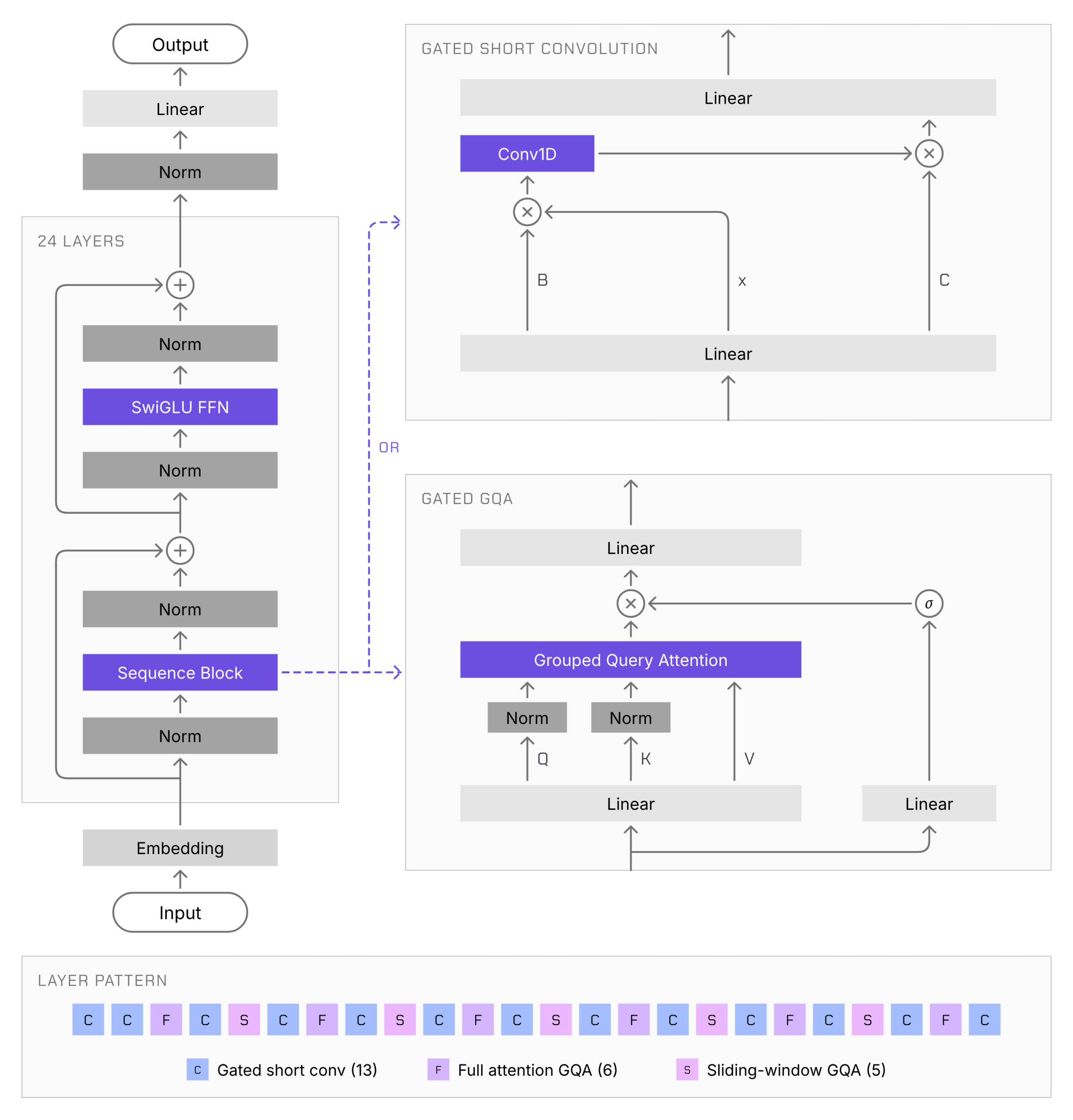
The text model, LFM3-1.7B, uses a new tri-hybrid architecture found through hardware-in-the-loop architecture search across 14 device and backend combinations, from phones and a Raspberry Pi 5 to laptops, cloud CPUs, GPUs, and the Qualcomm Hexagon NPU. The 24-layer base mixes 13 gated short convolutions with kernel size 7, 5 sliding-window attention layers with a 256-token window, and 6 global attention layers. Head-wise gated attention lets heads switch off, which helps suppress quantization outliers, and partial RoPE in global attention layers rotates only the highest-frequency half of each head. Sandwich norm keeps activations well-scaled. The result is that LFM3-1.7B matches LFM2-1.2B on short prompts per parameter and is about 25% faster with 8K tokens in context. The base was pre-trained on 22T tokens with a final 3.5T-token mid-training stage on curated data with more agentic traces and tool calls, extending the context window to 256K tokens.
Every LFM3 model branches from LFM3-1.7B-Base. LFM3-VL-2B accepts text, images, and video; LFM3-Audio-2B handles text and audio with text and speech output; LFM3-Omni-2B is the first omni model, taking text, images, video, and audio and responding in text or speech. The d1-2B and d1-omni-2B decision models answer structured questions with calibrated probabilities, now including object pointing, document reading, range estimation, and multi-select choices. Two in-house encoders support the multimodal models: a 164M-parameter vision encoder that uses 3x less compute than SigLIP2 and matches Qwen3.5-2B’s vision encoder accuracy with 2.2x fewer FLOPs, and a fully causal audio encoder that enables prefill while the user speaks, with time to first token as low as 50 ms. LiquidCodec, the new audio tokenizer, synthesizes speech at about 87x real time on a single CPU thread on Apple M4 Max.
The post includes several benchmark claims. LFM3-1.7B outperforms LFM2.5-2.6B with 35% fewer parameters, scoring 38.42 versus 3.02 on WebArena-Verified and beating Qwen3.5-9B on long browser and business-app tasks. LFM3-VL-2B has 1.9B parameters and raises the average across 62 vision benchmarks from 57.6 to 71.4 compared with LFM2.5-VL-3B, on par with Gemma 4 12B. LFM3-Audio-2B improves speech quality on UTMOSv2 from 3.22 to 3.83 and adds audio understanding and tool calling. LFM3-Omni-2B beats models up to 10.7B parameters on Daily-Omni, WorldSense, and AV-SpeakerBench. d1-2B scores 75.5 versus 64.0 on ImajevBench while replacing d1-3B with a third fewer parameters.
The article provides transformers code snippets for each model, with version requirements such as transformers>=5.21.0 for vision and >=5.20.2 for audio and omni. It also lists fine-tuning notebooks covering SFT, DPO, GRPO, and CPT for text, vision, audio, and omni tasks, and demonstrates adapting LFM3-VL-2B into robotics models for orchestration, navigation, and manipulation. The resulting VLA, jointly trained across 15 embodiments, achieves 96.2% average success across the four LIBERO suites and 45.7% on RoboCasa-GR1, generating action chunks in under 50 ms on a Jetson AGX Orin with TensorRT FP16. All models are open-weight on Hugging Face.