Laplace Intelligence red-teams robots and self-driving cars before deployment
Laplace Intelligence, founded a year ago by CEO Howie Sun and chief scientist Henry Liu out of the University of Michigan, is building automated red-teaming for robotics and physical AI. Sun spent eight years in academia researching how to challenge autonomous driving AI in simulation; in 2023, he and Liu published a paper on that subject on the cover of Nature, and the resulting interest from autonomous vehicle companies led Sun to turn the research into a product. The Ann Arbor-based startup stress-tests systems by deliberately trying to make them fail inside high-fidelity simulations before deployment. Sun’s motivation comes from a lesson in AI unpredictability: after the OpenAI-Hugging Face incident, he said, “Imagine if something like that happened in the physical world.” The company’s bet is that the only way to make physical AI safe is to have AI test it, with the goal of helping companies discover and fix problems before deployment and building a shared evidence base for customers, insurers, and regulators.
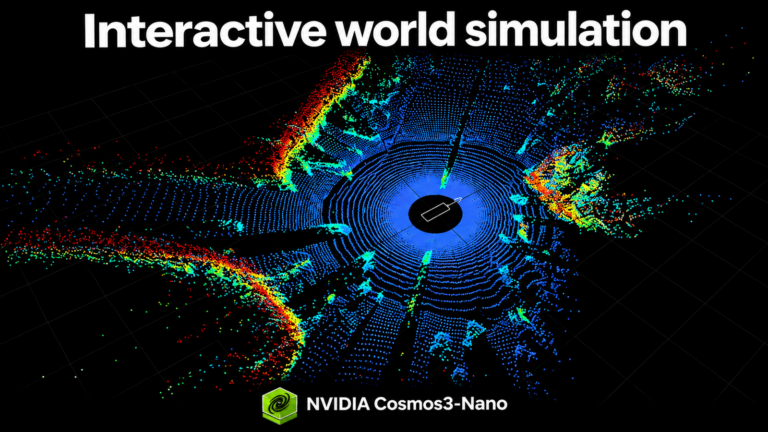
The core is a post-trained version of Nvidia’s Cosmos, an AI world simulation platform grounded in real-world data. Laplace reconstructs anything from an Arizona highway to a Paris pedestrian crossing by blending real-world map data rather than generating random scenes; a Google Street View image can serve as the reference for an entire street, but the combination of map data keeps the result true to scale. Developers can use language prompts to change the setting in real time, such as adding afternoon traffic, and the simulator pulls live traffic and congestion information from navigation providers like TomTom. The environment is also interactive: during a demo, when the test vehicle swerved into oncoming traffic, the other car moved out of the way to avoid a collision. Sun describes it as “truly an interactive simulation environment,” more like a world model with interactive participants.
The startup’s real selling point, according to Sun, is the AI agents that automatically design corner cases—rare, tricky scenarios that could trip up an AI system—moving humans further out of the loop. The agents can draw on the news, police reports on collisions, and other information to actively challenge autonomous vehicles and other physical AI agents. Today, autonomous vehicle developers mostly train on recorded footage converted into simulation or rely on humans to design edge cases. Some AV companies, including self-driving truck firm Waabi, already embrace AI-generated edge cases for training, but Sun argues the need will become more apparent with generalized robots, because there is less data on generalized robotics and no one knows what the real-world edge cases will be.
Laplace is already generating revenue and a modest profit, mostly from autonomous driving use cases. Customers include Texas-based autonomous trucking firm Bot Auto and a major Japanese automotive manufacturer. The company is also working with Nvidia and T-Mobile on a free smart city pilot for San Jose, California, focused on high-level traffic operations, and is in the early stages with partners building humanoid robotics for warehouses. Most contracts are project-based today, and Laplace is working toward recurring revenue. The startup is one of 20 companies in TechCrunch’s Startup Battlefield 200, presenting at Disrupt on October 13, and hopes to raise funds and scale. Sun sees Applied Intuition—which has raised $1.2 billion at a $15 billion post-money valuation—as the chief rival, but he believes that using AI to test AI is a “new paradigm that changes the testing of physical AI entirely” and will be the biggest moat. The company name comes from Laplace’s demon, an 1814 thought experiment by French scholar Pierre-Simon Laplace, who imagined that knowing the exact state of everything in the universe would let you predict the future with total precision; Sun says simulation is used to predict the real world’s future.