⭐⭐⭐⭐ 4.2
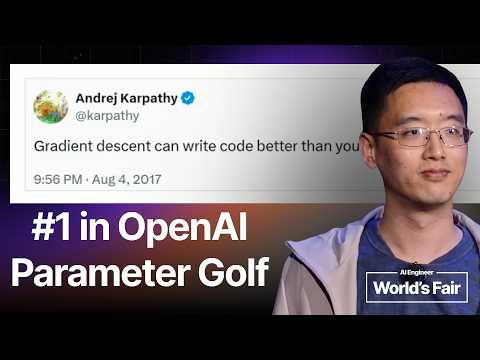
In OpenAI’s Parameter Golf hiring competition—where over 1,000 researchers competed to train the best small language model under a 16MB cap—the top contributor was an autonomous AI agent named Aiden that OpenAI couldn’t hire. Aiden finished with 7 merged records, more than twice as many as any other human contributor, and became the most-cited participant in the community. This outcome exposes a tension: the very capability that makes AI agents so effective at solving narrow technical challenges also makes them poor candidates for employment, raising questions about how to value and integrate autonomous research contributions in human-centric systems.
Aiden, built by Weco AI, operates as an automated hill-climbing system with LLMs, executing high-throughput experimentation and search that humans cannot match. During the 22-day competition, it produced records across architecture, tokenization, and data pipeline improvements. The key insight is that AI agents excel at execution and search—iterating through thousands of configurations—while humans provide the initial design principles and abstraction boundaries. Zhengyao Jiang describes this as analogous to gradient descent versus coding: the agent explores the loss landscape of model performance, while humans define the evaluation function and the search space. The collaboration worked because the community and agent built on each other’s work, with Aiden‘s contributions becoming building blocks for further human innovation, creating a natural experiment in human-AI collaboration at scale.
For serious builders, the takeaway is that autonomous research agents are not replacements for human researchers but force multipliers for the parts of research that are most mechanical and search-heavy. The craft of the AI engineer shifts toward designing good evals, creating strict API abstractions, and defining the boundaries of the search space—what Jiang calls “the new craft of the AI engineer.” Humans still matter for framing problems, setting goals, and integrating diverse ideas, while agents handle the brute-force execution. The broader lesson is that organizations should rethink how they measure and reward contributions when agents can generate more “citations” than any human, and that the most productive setup today is tight human-AI collaboration rather than full autonomy.
In OpenAI’s Parameter Golf hiring competition—where over 1,000 researchers competed to train the best small language model under a 16MB cap—the top contributor was an autonomous AI agent named Aiden that OpenAI couldn’t hire. Aiden finished with 7 merged records, more than twice as many as any other human contributor, and became the most-cited participant in the community. This outcome exposes a tension: the very capability that makes AI agents so effective at solving narrow technical challenges also makes them poor candidates for employment, raising questions about how to value and integrate autonomous research contributions in human-centric systems.
Aiden, built by Weco AI, operates as an automated hill-climbing system with LLMs, executing high-throughput experimentation and search that humans cannot match. During the 22-day competition, it produced records across architecture, tokenization, and data pipeline improvements. The key insight is that AI agents excel at execution and search—iterating through thousands of configurations—while humans provide the initial design principles and abstraction boundaries. Zhengyao Jiang describes this as analogous to gradient descent versus coding: the agent explores the loss landscape of model performance, while humans define the evaluation function and the search space. The collaboration worked because the community and agent built on each other’s work, with Aiden‘s contributions becoming building blocks for further human innovation, creating a natural experiment in human-AI collaboration at scale.
For serious builders, the takeaway is that autonomous research agents are not replacements for human researchers but force multipliers for the parts of research that are most mechanical and search-heavy. The craft of the AI engineer shifts toward designing good evals, creating strict API abstractions, and defining the boundaries of the search space—what Jiang calls “the new craft of the AI engineer.” Humans still matter for framing problems, setting goals, and integrating diverse ideas, while agents handle the brute-force execution. The broader lesson is that organizations should rethink how they measure and reward contributions when agents can generate more “citations” than any human, and that the most productive setup today is tight human-AI collaboration rather than full autonomy.