GPT-6 and Intelligent UI in ChatGPT
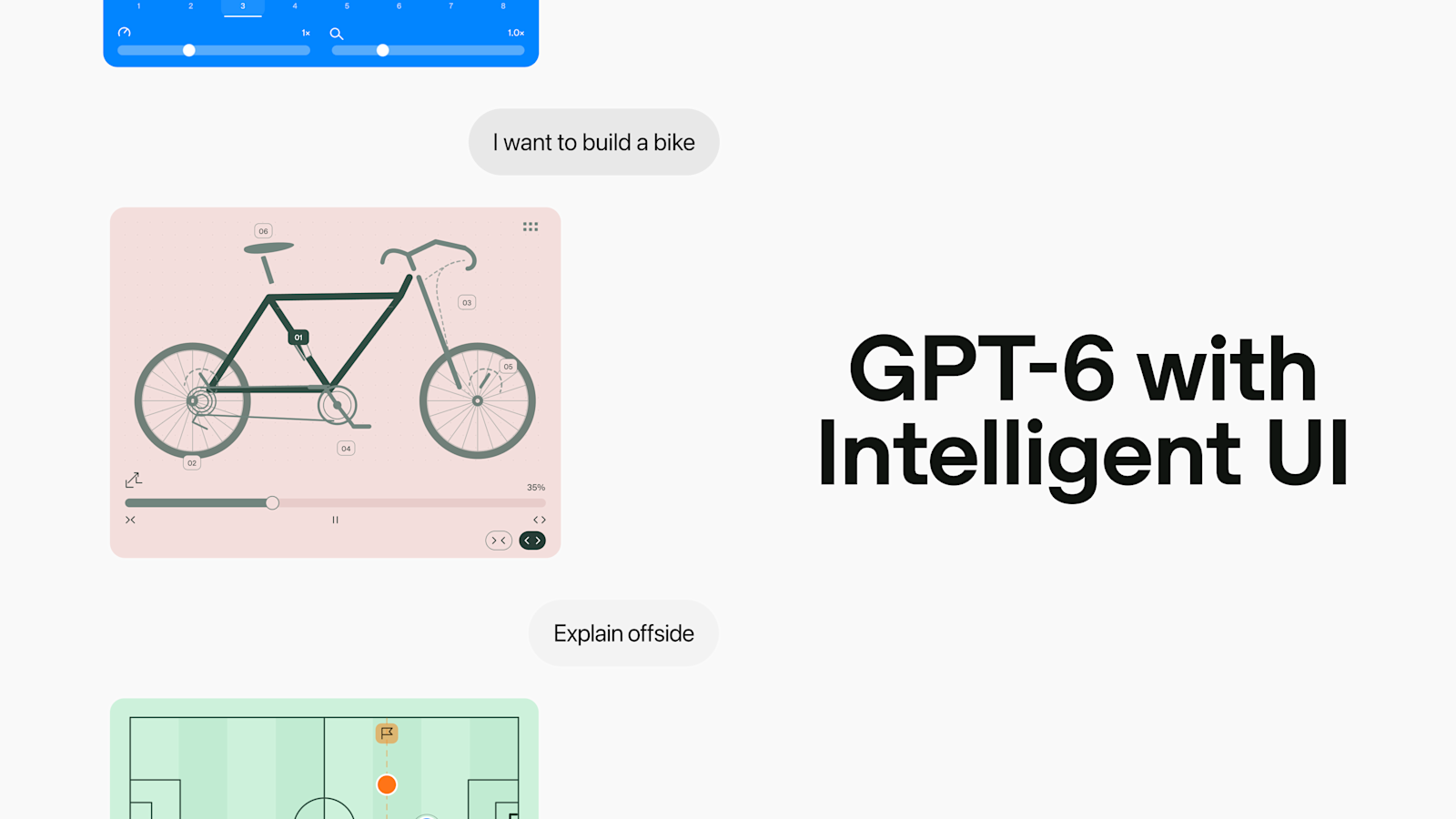
OpenAI is rolling out GPT-6 to more users, including free tiers, and introducing Intelligent UI, a new ChatGPT capability that lets the model compose responses using text, visuals, and interactive elements chosen for each question. The announcement focuses on three practical benefits: more visual answers to everyday questions, easier learning of complex topics, and the ability to create small interactive tools on demand. For example, ChatGPT can place recipe timing next to instructions, show road-trip stops on a map with notes, let users change an input in an interactive diagram to see what happens, or generate a savings calculator, bill splitter, or playable game directly in the conversation.
Intelligent UI works through a library of native, streamable components and a compiler that processes the interface as the model generates it. The component library gives responses a consistent design foundation while leaving GPT-6 room to decide how pieces fit together. The compiler lets the interface appear progressively instead of making users wait for the full response. Training methods were expanded to help the model make deliberate choices about content, layout, visuals, and interaction, with evaluations focused on clarity, usefulness, and completeness. The model also learns when interactivity is useful and when a plain text answer is sufficient. OpenAI states there is still work ahead to improve the model’s design judgment and expand what it can create, but positions Intelligent UI as a shift away from forcing every question into the same conversational format.
GPT-6 also changes how ChatGPT handles latency. With earlier reasoning models, users had to wait for the model to finish thinking before receiving an answer. GPT-6 is trained to interleave thinking with answering, taking the user’s waiting time into account and progressively composing an answer using knowledge and findings available up to that point. It builds answers across multiple partial responses, adding useful information without filler, while keeping the final answer cohesive and factual. In an internal evaluation of high-value, everyday agentic tasks, GPT-6 Extra High began answering in the same time as GPT-5.6 Medium while scoring better overall than GPT-5.6 Extra High. For questions requiring web search, GPT-6 Instant starts answering 44% sooner on average than GPT-5.6 Instant. GPT-6 also improves web-search answer quality by making better decisions about when to look something up and by more reliably finding supporting information; in an internal evaluation of difficult problems, it addressed the key aspect of the user’s question more often than GPT-5.6.
On safety, OpenAI says GPT-6 builds on Astra’s safety advances to improve risk recognition, honesty, and respect for user-set limits. Safety training was updated using lessons from real-world deployment to strengthen protections against high-risk misuse involving cyberattacks, biological threats, and violence. In adversarial testing, GPT-6 showed stronger resistance to safety bypass attempts, particularly multi-turn adaptive attacks. The model is also trained to respond safely in higher-risk scenarios while avoiding unnecessary refusals of harmless requests, using conversation history and context to spot risks not apparent from a single prompt. Alignment evaluations covered honesty and responses to safety restrictions; GPT-6 is better at recognizing and communicating its own capability limits, including when it lacks information or tools. The announcement points to a system card for more detail.
Availability begins with ChatGPT Plus, Pro, Business, and Enterprise tiers today in the Chat tab, expanding to Free and Go tiers tomorrow. Enterprise rollout depends on workplace admin settings. GPT-6 Sol powers Plus, Pro, Business, and Enterprise, while GPT-6 Luna powers Free and Go tiers; both are tuned for everyday conversation. The update applies only to the Chat experience, and the models powering Work and Codex are not changing as part of this release. OpenAI frames Intelligent UI as a step toward a ChatGPT that shapes an interface around what a person is trying to do, with the long-term goal that software adapts to people rather than people adapting to fixed software interfaces.