Google’s WeatherNext 3 beats rivals with higher resolution and hourly forecasts
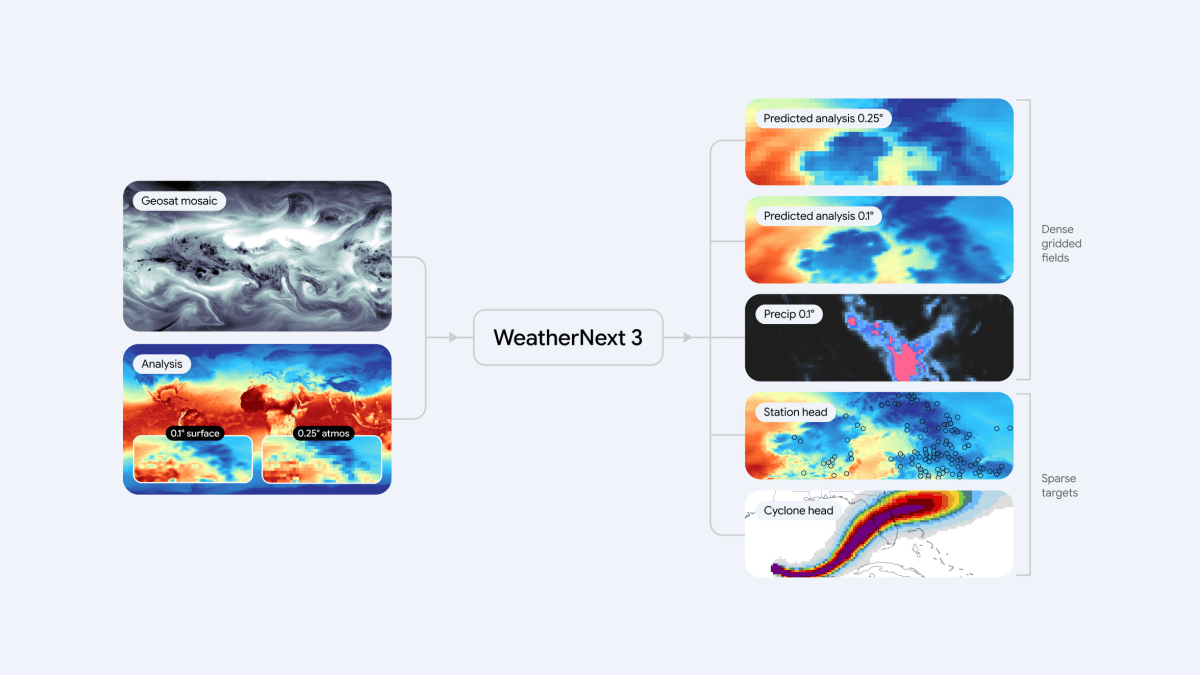
Google DeepMind and Google Research have released WeatherNext 3, a new AI weather forecasting model that addresses key weaknesses of earlier deep-learning approaches. The model predicts at a resolution of 5 square kilometers, shows a 60% improvement in rain forecasting over WeatherNext 2, and produces hourly forecasts instead of the standard six-hour interval. Google plans to feed WeatherNext 3 into its consumer products including Search, Maps, and Gemini, and make it available on Google Cloud.
On the Operational WeatherBench benchmark from the startup Brightband, WeatherNext 3 outperformed other AI models from Google, Microsoft, Nvidia, and the European Centre for Medium-Range Weather Forecasts (ECMWF), as well as traditional forecasts from the U.S. National Weather Service and the ECMWF. The model is 2.4 times larger than its predecessor, with tailored decoder heads and training that targets specific weather stations, enabling evaluation against ground-truth data. It can also ingest raw satellite observations on an hourly basis, though it still relies on formatted national weather datasets. Google claims WeatherNext 3 is the first AI model to directly incorporate raw observations for a high-resolution global forecast, though competitor WindBorne states its WeatherMesh 6 model has done so since late 2025.
The broader context is that AI models are transforming meteorology by delivering fast, cheap forecasts that could benefit regions where supercomputing costs are prohibitive. DeepMind researcher Ferran Alet highlighted that higher-resolution wind, rain, and cloud cover forecasts could also make renewable energy projects more dependable.