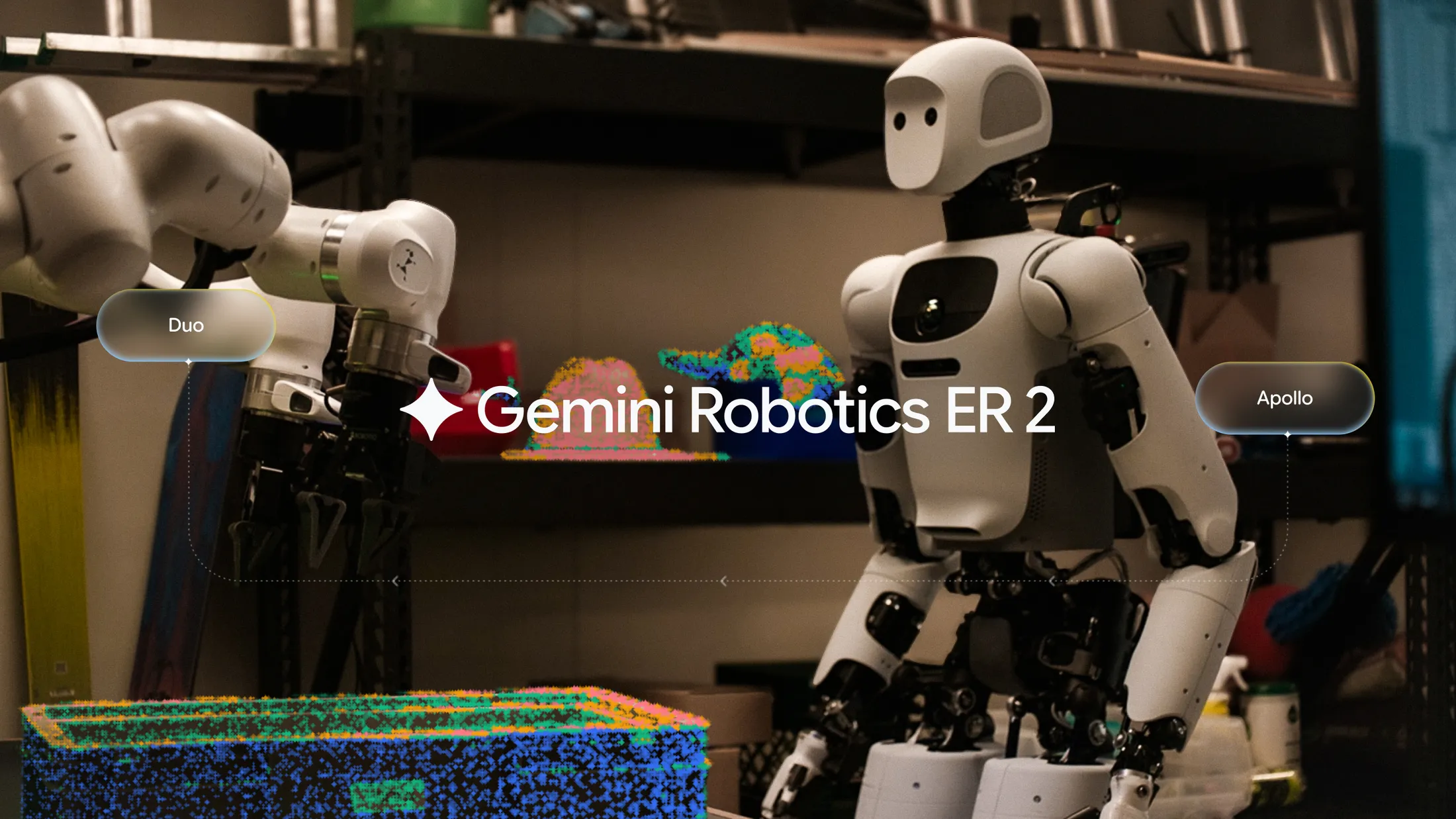
Gemini Robotics ER 2 now in public preview on Google Cloud
Google has made Gemini Robotics Embodied Reasoning 2 (ER 2) available in public preview on the Gemini platform, extending the embodied reasoning model that was introduced earlier this year as part of Gemini Robotics 2. ER 2 is a specialized Gemini model that serves as a robot’s high-level brain. It combines spatial and temporal video understanding with long-horizon planning and built-in safety guardrails, working across stationary arms, wheeled rovers, quadrupeds, full humanoids, and other embodiments. The model can converse naturally with humans, orchestrate low-level action models and hardware APIs, execute multi-minute tasks involving hundreds of decisions, and collaborate across multi-robot teams. The public preview is the first time organizations can pair Google DeepMind‘s latest embodied reasoning model with Google Cloud‘s enterprise-grade security, multi-agent orchestration, and end-to-end lifecycle management.
According to the announcement, ER 2 transforms a robot into a physical agent that can reason over continuous video feeds and know whether a step succeeded before moving on. It classifies task progress into binary status, discrete categories, or continuous scores, which improves real-time situational awareness and allows adjustment or iteration on failed steps without restarting an entire workflow. The model pinpoints the exact video frame where a critical event occurs — such as when to stop pouring a liquid — with 91.3% accuracy and a 0.96-second mean absolute frame distance, running at 4x the execution speed and a fraction of the compute cost of many larger model categories. It also advances core spatial reasoning, including visual question answering and instrument reading across 10+ instrument categories such as circular dials, sight glasses, digital displays, linear scales, rulers, and liquid thermometers.
ER 2 is positioned as one intelligence layer across any embodiment, scaling from stationary arms to complex forms and enabling multi-robot collaboration: different types of robots share a semantic understanding of their workspace, divide labor, and hand off tasks to complete workflows a single machine could not do alone. The model also performs agentic tool orchestration while thinking about what comes next. Developers can declare low-level control interfaces — VLA models, navigation APIs, or custom functions — as tools across simulation, real-world robot control, or human tele-operation. Natural language commands can drive navigation and manipulator movement APIs, and the robot can explain its approach while performing an action, letting operators redirect it without using technical language.
On Google Cloud, the intended development workflow covers simulation, training, and deployment. Teams can test behaviors in MuJoCo-Warp and NVIDIA Isaac Sim before touching hardware, generate synthetic scenarios with multimodal models, and auto-label workcell imagery. Gemini Robotics ER 2‘s spatial pointing, moment finding, and progress classification can curate and label demonstration videos in Cloud Storage and BigQuery, then feed training of custom Vision-Language-Action (VLA) models through the Gemini platform, GKE, or Cluster Director. Deployment runs Gemini Robotics ER 2 workflows on the Gemini platform with enterprise IAM, security controls, and built-in function calling; latency-sensitive local workloads like SLAM and path planning can be offloaded to factory floors with Google Distributed Cloud, and fleet telemetry can be streamed into BigQuery.
The announcement includes customer statements from Boston Dynamics, DeepReach, Arm, and ASTAR IMRE. Boston Dynamics’ Spot VP says video-based inspection changes what an inspection can be; DeepReach uses ER 2 for accurate task understanding of recordings to build a data flywheel for model training; Arm sees advanced reasoning models as an important step toward next-generation robotics compute platforms; and ASTAR IMRE is using ER 2 to give robots visual and physical flexibility in lab automation, moving toward self-driving labs. Developers can get started in preview via Model Garden in the Gemini platform, with documentation, sample code, bidirectional streaming guides, and a research announcement containing benchmarks and a safety technical report.


