⭐⭐⭐⭐ 4.2
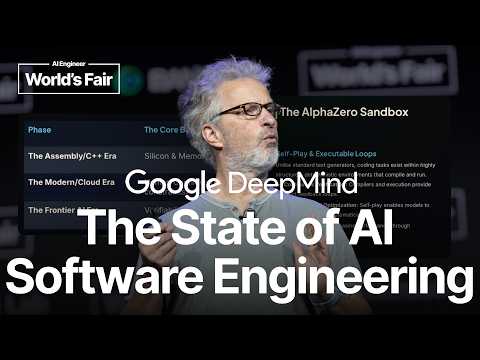
Benoit Schillings, VP of Technology at Google DeepMind, directly confronts a tension many in AI feel but few state outright: syntax generation is over. The raw ability to produce correct-looking code is no longer the bottleneck. Instead, the constraint has shifted to architecture, validation, and the deep reasoning that happens before a single token is emitted. As human-generated training data approaches saturation, the old approach of supervised fine-tuning on human examples is hitting diminishing returns. The real problem is no longer teaching a model to write code—it is teaching it to think about what to write and why.
Schillings sketches a concrete technical path forward built on self-play and inductive architecture. DeepMind is already moving beyond static datasets by having models generate their own challenges and verify their own solutions, a technique that has driven superhuman performance in games and is now being applied to code and reasoning. The next leap, he argues, is not more token prediction but models that can plan, decompose complex problems, and transfer knowledge across domains. This shift also changes the engineering economics of software: with writing code nearing zero cost, the critical investment must go into active guardrails, security scans, and managing the explosion of machine-generated artifacts.
For a serious builder, the takeaway is that the job title “software engineer” is being redefined from “someone who writes code” to “someone who validates and orchestrates systems that write code.” Schillings pushes this further: the same reasoning capabilities that allow a model to plan a codebase also unlock rapid experimentation in fields like chemistry and biology, where AI can uncover patterns invisible to human perception. The practical takeaway is not to chase better syntax models but to invest in the architecture of verification, self-play training pipelines, and evaluation benchmarks that reward genuine reasoning over fluent text generation.
Benoit Schillings, VP of Technology at Google DeepMind, directly confronts a tension many in AI feel but few state outright: syntax generation is over. The raw ability to produce correct-looking code is no longer the bottleneck. Instead, the constraint has shifted to architecture, validation, and the deep reasoning that happens before a single token is emitted. As human-generated training data approaches saturation, the old approach of supervised fine-tuning on human examples is hitting diminishing returns. The real problem is no longer teaching a model to write code—it is teaching it to think about what to write and why.
Schillings sketches a concrete technical path forward built on self-play and inductive architecture. DeepMind is already moving beyond static datasets by having models generate their own challenges and verify their own solutions, a technique that has driven superhuman performance in games and is now being applied to code and reasoning. The next leap, he argues, is not more token prediction but models that can plan, decompose complex problems, and transfer knowledge across domains. This shift also changes the engineering economics of software: with writing code nearing zero cost, the critical investment must go into active guardrails, security scans, and managing the explosion of machine-generated artifacts.
For a serious builder, the takeaway is that the job title “software engineer” is being redefined from “someone who writes code” to “someone who validates and orchestrates systems that write code.” Schillings pushes this further: the same reasoning capabilities that allow a model to plan a codebase also unlock rapid experimentation in fields like chemistry and biology, where AI can uncover patterns invisible to human perception. The practical takeaway is not to chase better syntax models but to invest in the architecture of verification, self-play training pipelines, and evaluation benchmarks that reward genuine reasoning over fluent text generation.