Eka Robotics raises $150M at $1.45B valuation for its force-based physical AI
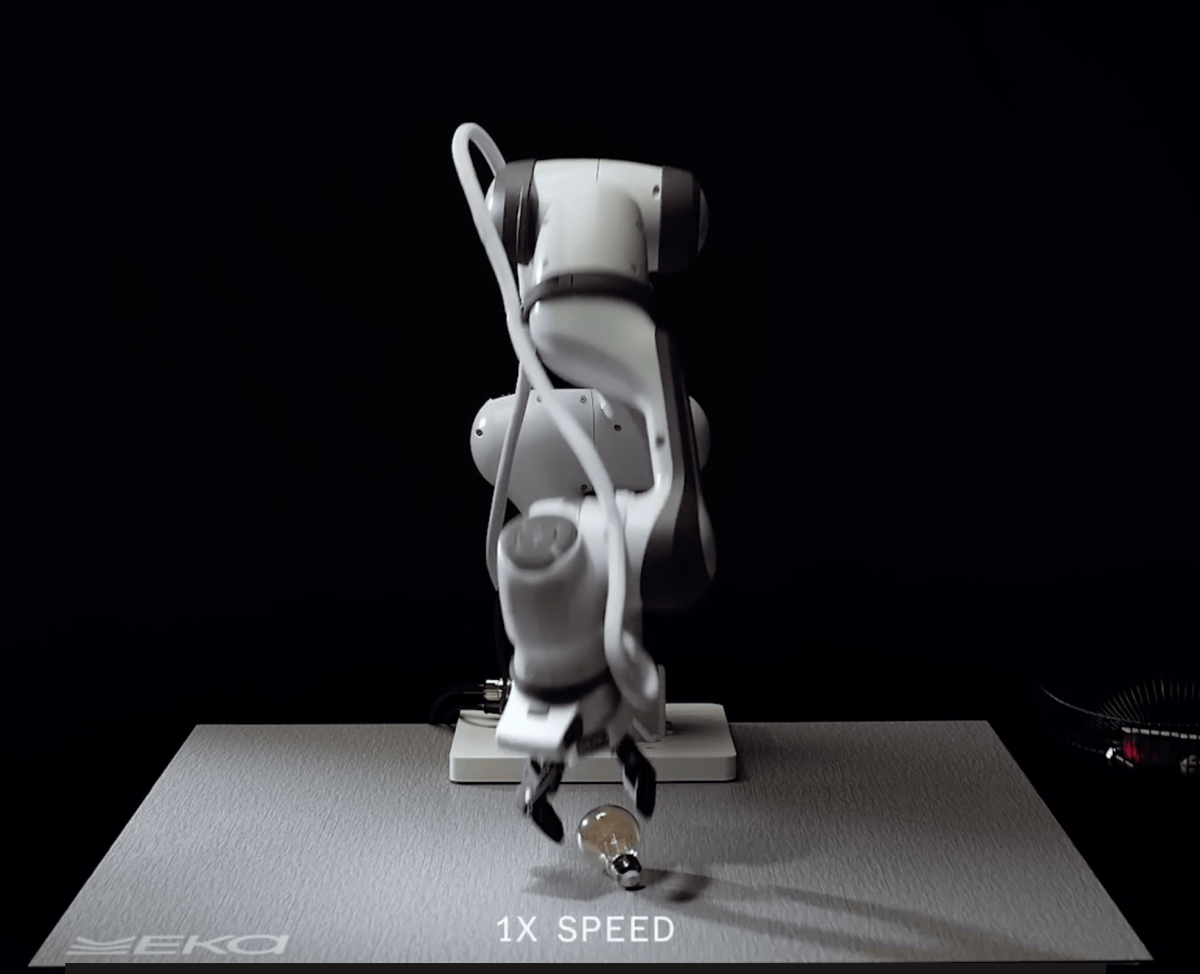
Robots still struggle with picking things up, but Eka Robotics is betting that a new manipulation architecture—a force-sensitive gripper paired with a deep-learning model built around touch and force—can close the gap. Founded by MIT professor Pulkit Agrawal and former Google DeepMind researcher Tuomas Haarnoja, the startup has raised a $150 million Series A led by a16z and F-Prime at a $1.45 billion post-money valuation. The founders, who met in graduate school at UC Berkeley, are leading researchers in reinforcement learning for robotics control.
Early reactions from roboticists are unusually strong. Raghu Raguram of a16z says Eka is already exceeding superhuman performance for certain tasks, with superhuman performance in many dexterous manipulation tasks possible within months. Kris Hauser of the University of Illinois Urbana-Champaign called it a “wow factor,” noting the robot adapted to many objects without retraining and showed a “humanness” by trying again after failure. An anonymous researcher at a frontier lab compared the experience to seeing reliable legged locomotion appear five to ten years ago. The robot can pick up about 1,500 objects weighing up to 1 kg in an hour, compared with roughly 600 for a human, and Eka says it reliably picks up objects more than 95% of the time. The arm is fast and strong enough to hurt itself, which the observer read as genuine trust in the algorithm.
Technically, Eka’s model is a vision-force-action model rather than a vision-language-action model. Agrawal says vision gives a rough sense of where an object is and its pose, but the actual grabbing and searching happen through forces. That led Eka to design a more flexible hand with added force sensors; it reacts to contact, which is why it can take a raspberry without crushing it. The founders are cagey about implementation, but the core idea is a physics simulator that models the forces of grasping and creates a reinforcement learning environment that can run at scale. They say they can generate thousands of hours of robot experience in minutes, freeing the robot from the limits of human demonstrations and from videos collected by gig workers or robot operators. Simulation has historically been harder for contact-rich manipulation than for tasks that avoid objects. As Agrawal puts it, Eka is trying to bridge the generality-performance gap that plagues modern robotics.
The approach is a deliberate counter to much of the field. Today’s most generalizable physical AI models are not particularly good at tasks, while task-specific models may not make business sense. Astra, ChatGPT’s latest LLM, can operate a robot in an unfamiliar setting, but slowly and at high cost. Eka’s promise is to handle physical execution while a general model plans—Astra may know plates go in a cupboard, but Eka’s model can pick up a dish without breaking it. Haarnoja says much of the field pushes high-level planning downward, while Eka builds from the physical upward. That bet gives weight to critics like Rodney Brooks, who argue that robotics models need to represent force and touch.
Eka still needs to prove itself outside the lab. The company is running secretive pilots with industrial customers in pick-and-place and wire manipulation, but Hauser warns that real assembly lines require a system to run without breaking for an entire year. He also questions how far the techniques generalize beyond pick-and-place, since many value-added industrial tasks require more. Agrawal is focused on deployability: the gripper costs less than $1,000, is rated for 5 million duty cycles, and the goal is 20 million cycles, the bar set by standard industrial arms. The company is starting pragmatically with two verticals—pick, arrange, place and wire handling—and wants home runs in those before expanding.