DynaPORT Modernizes with AlloyDB and GKE
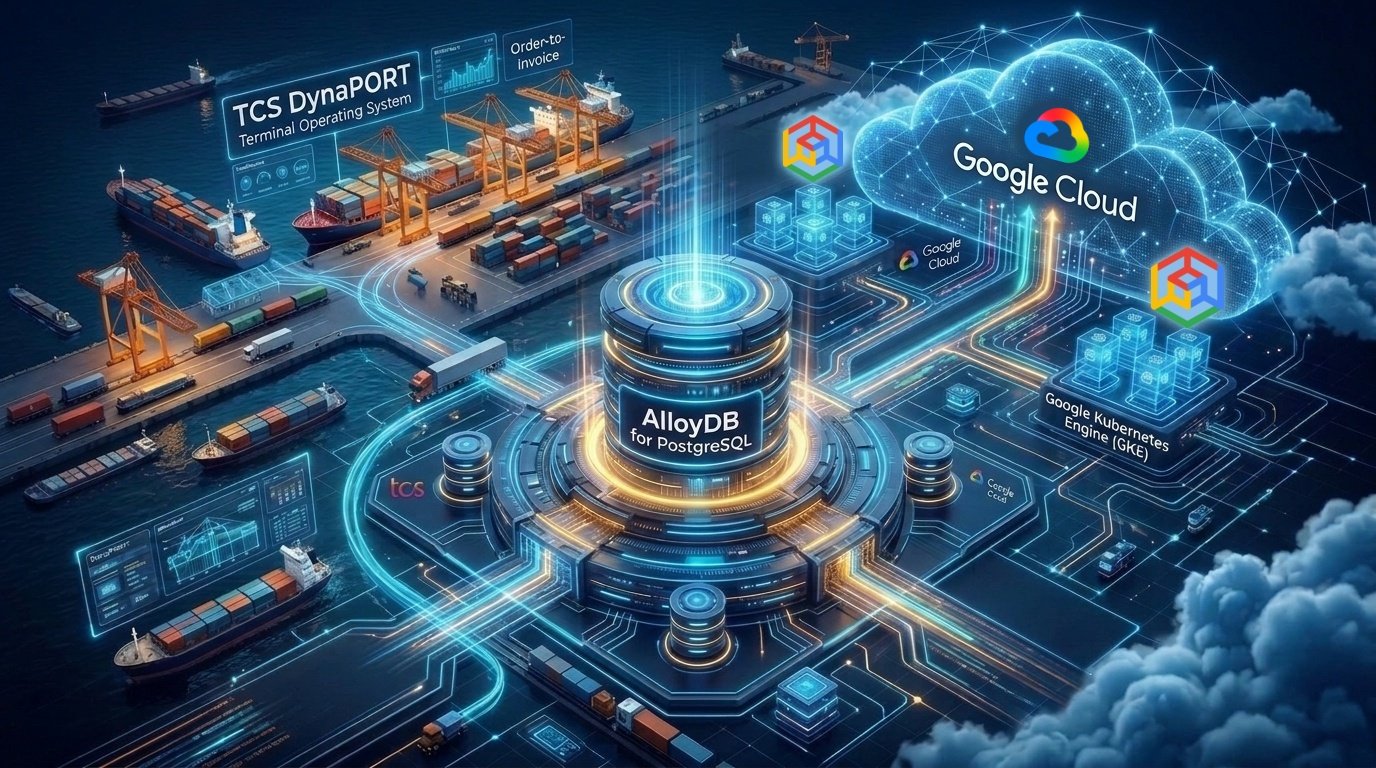
Tata Consultancy Services (TCS) and Google Cloud describe the modernization of DynaPORT, a next-generation Terminal Operating System (TOS) for marine ports. DynaPORT orchestrates the full order-to-invoice lifecycle across vessel, rail, truck, and barge operations, supporting containers, general cargo, dry and liquid bulk, break-bulk, and roll-on/roll-off cargo. One of India’s largest commercial port developers and operators has used DynaPORT for more than two decades across its cargo terminals. The joint effort migrated the platform from a monolithic on-premises Oracle-based stack to a cloud-native architecture built on Google Kubernetes Engine (GKE) and AlloyDB for PostgreSQL.
The legacy platform had accumulated significant architectural debt. In the DynaPORT Cargo module alone, the core schema contained 2,760 tables, 555 sequences, 262 packages with over 1.2 million lines of code, 54 stored procedures, 53 functions, and 63 database triggers, along with cross-schema user-defined types. Critical business operations—multi-tiered marine invoice tariff calculations, dynamic slab rating, berth allocation, yard truck assignments, and autonomous error logging—were embedded in complex PL/SQL procedures. The database had effectively become the enterprise’s primary execution engine. The application tier ran on monolithic WebLogic and WildFly servers on static on-premises VMs, using Enterprise JavaBeans, custom ORM dialects, and heavy configuration state. Shared JVM heaps meant a batch invoice generation spike could starve memory from real-time handheld terminals used by crane operators. Continuous delivery was practically nonexistent: releases required multi-hour maintenance windows, manual SQL script execution, package recompilations, and server restarts. Modifying one package specification frequently invalidated dozens of dependent functions, views, and synonyms, and environment drift required lengthy manual reconciliation. Commercial licensing scaled linearly with physical CPU core counts, and high-availability setups demanded complex shared storage arrays and dedicated DBAs.
When architecting the transformation, the customer, TCS, and Google Cloud teams evaluated two strategies. Strategy A was a database-agnostic migration that extracted all business logic from the database tier and rewrote it as Java application-tier services. The team rejected this because it required a massive rewrite of thousands of data access objects, ORM mappings, and transaction boundaries, costing multiple person-years and creating prohibitive time-to-market. Strategy B was modernization with AlloyDB, which retained the optimized procedural logic by converting it to PostgreSQL PL/pgSQL. This path required only focused remediation of syntax, metadata, and dialect differences, kept the application stable, and preserved native in-engine execution with sub-millisecond response times backed by AlloyDB‘s accelerated storage and compute engine. Strategy B was selected.
The target architecture follows the Google Cloud Architecture Framework, transforming monolithic JEE middleware into containerized microservices on GKE with an enterprise AlloyDB for PostgreSQL cluster. The migration cornerstone was converting over 1.2 million lines of Oracle PL/SQL into PostgreSQL PL/pgSQL. Google Cloud Database Migration Service (DMS) with its built-in Conversion Workspaces and Gemini-assisted AI code refactoring handled the majority of standard DDL, functions, and queries. Approximately 15% of the code involved complex Oracle proprietary idioms and required targeted manual remediation. One example is replacing Oracle’s dynamic array allocation using TYPE_L.EXTEND with native PostgreSQL array concatenation or dynamic index expansion. Another is replacing ROWNUM-based deterministic row generation with generate_series in-memory set-returning functions, eliminating the physical dummy table hack and zero disk I/O.
The modernized DynaPORT platform went live in production at one of India’s newest ports in April 2026, with a low-downtime cutover; by August 2026, three more terminals had gone live. Reported outcomes include up to 2x transactional throughput, sub-second read query responses, automated ML vacuuming, sub-second automatic failover with 99.99% availability SLA inclusive of maintenance and zero transaction loss, containerized rolling updates on GKE, non-blocking transactional DDL deployments, about 50% reduction in database TCO with fully open-source-compatible pricing, and instantaneous horizontal elasticity across GKE pods and AlloyDB read pools.
Three architectural lessons are stated: do not throw away proven intellectual property—migrating Oracle PL/SQL to PL/pgSQL on an accelerated engine preserves tested business rules while modernizing the platform; select database engines built for cloud realities, since AlloyDB‘s disaggregated storage, columnar acceleration, and built-in ML intelligence provide the enterprise muscle to replace legacy commercial engines; and containerize application workloads on GKE to absorb operational surges without affecting core database stability.