Building Six Small Models with ML Intern for About USD 103
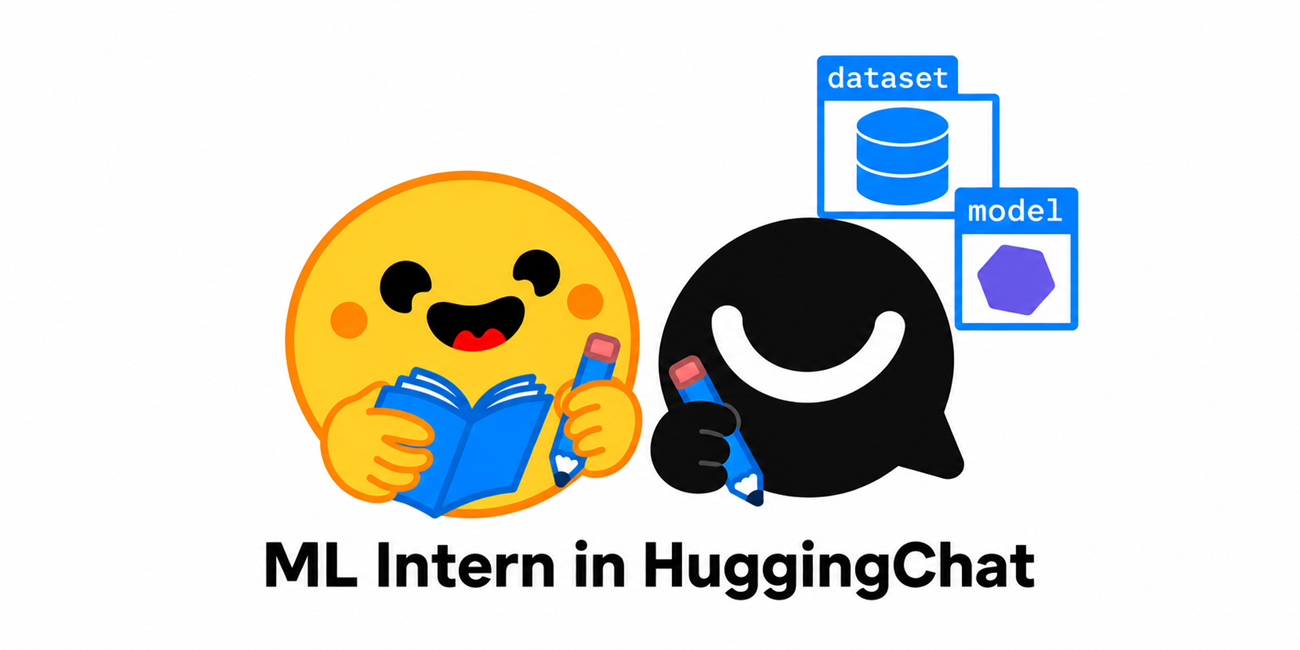
An engineer used ML Intern, the agent mode in HuggingChat, to create six small models that did not exist publicly, spending about USD 103 total on compute. The first project was a compact prompt rewriter for Qwen-Image 2.1: the official 9B model needs about 20 GB of memory and generates thousands of tokens before writing one paragraph, and the Hub only had compressed copies of it. Describing the desired behavior to ML Intern produced a 0.8B student that runs on a CPU, returns valid output 99.7% of the time, uses roughly a quarter of the teacher’s tokens, and cost USD 16, including using the 9B model to label 8,797 example requests.
The author’s main effort goes into the first prompt. The initial citrus prompt was about 450 words; by the sixth project it was closer to 2,000. All seven prompts are public at yvrjsharma/ml-intern-prompts. A prompt starts with a one-line idea and the reason, then names the exact dataset, base model, and training script. Anything already checked goes under a ‘Verified facts, do not re-derive’ heading so the agent spends its budget on work instead of rediscovering known details. Two instructions are critical: ask for a baseline before training, e.g., the base model’s zero-shot score on the same metric, and ask for a smoke test with a concrete check, such as 50 training steps followed by verifying saved weights changed before paying for the full run. The prompt ends with expected deliverables and a strict budget cap such as ‘Cap total spend at USD 12 and ask me before exceeding it.’ ML Intern starts each task with a zero-dollar budget and must ask permission before paid jobs, so the cap is enforced.
ML Intern then built the six models. Citrus Doctor: ML Intern fine-tuned Qwen3.5-2B on citrus-disease-vlm-instruct, a dataset of 3,017 annotated images covering 21 pests, illnesses, nutritional gaps, and treatments. On 335 test photos, the base model named the right problem 14.9% of the time; after two epochs on one A10G, the fine-tuned model reached 52.8%, at about USD 1.90 in compute.
Huggy LoRA: trained on 84 captioned drawings of Huggy with FLUX.2 klein base 4B, costing about USD 7.60. The agent saved checkpoints every 100 steps and rendered the same prompts with each; step 200 was the first fully on-model result, while style bled into unrelated prompts from step 500 onward. The LoRA also works on the distilled klein model at 4 steps.
Viewpoint Orbit LoRA: no camera-angle LoRA existed for Qwen-Image 2.1 days after release, so ML Intern rendered 1,030 Google Scanned Objects at 24 angles each (24,722 transparent images) on CPU, finalized 461 objects for training and 40 for testing, and created 1,844 before-and-after pairs across 23 camera instructions. Two thousand training steps ran in about 90 minutes on one A100; the whole project cost about USD 16, including failed jobs that ML Intern resubmitted.
Doodle-in LoRA: with no existing dataset, the prompt described generating one from Open Images photos, removing objects with the LaMa inpainting model, and drawing a magenta scribble in the removed region. ML Intern built 6,042 training pairs and a 160-pair test set, with 40 pairs from 23 object classes held out of training, while recording the author and license of every source photo. It measured the base model alone and with Viggle turbo LoRA before training, ran 2,000 steps in 1 hour 38 minutes for about USD 4, and chose step 500 from checkpoint comparisons. Paired with Viggle turbo LoRA at 6 steps, 67.5% of objects were detected where drawn at 4.7 seconds per edit; unseen classes performed comparably (65.0% vs 64.2%). Total cost about USD 24.
Pocket rewriter: ML Intern generated 8,797 image requests with a small instruct model, had the 9B teacher rewrite them on one A100 in 2 hours 37 minutes (~USD 6.50), filtered to 1,840 examples, and trained 0.8B and 2B students on an A10G (USD 0.75 total). The 0.8B ships as an 812 MB GGUF for CPU. Project cost about USD 16.
Agate 4-step: Logolabs’ Agate Preview 002 is a 260M-parameter text-to-image model needing 50 steps with guidance, or 100 network passes per image. ML Intern distilled it to 4 passes in two runs. The first cached 155,000 training images as latents, baked guidance into the model, cut step counts from 16 to 8 to 4 on A100s, exported to ONNX, and the 4-step student beat the teacher run at the same 4 steps on GenEval and FID; that run cost USD 22. The second run made 24,000 more teacher pairs at 16 steps and fine-tuned the 4-step student for about an hour, raising GenEval from 0.509 to 0.536 versus the teacher’s 0.563 at 50 steps; total across both runs was about USD 37.
Total compute for all six projects came to about USD 103. The author’s advice is to start from a model you wish existed and a dataset you have or can describe, give a small budget, ask for a baseline and a smoke test, and inspect results before raising the cap. The example prompts are free to copy from the GitHub repository.