Building Durable Agentic Systems with Google Antigravity
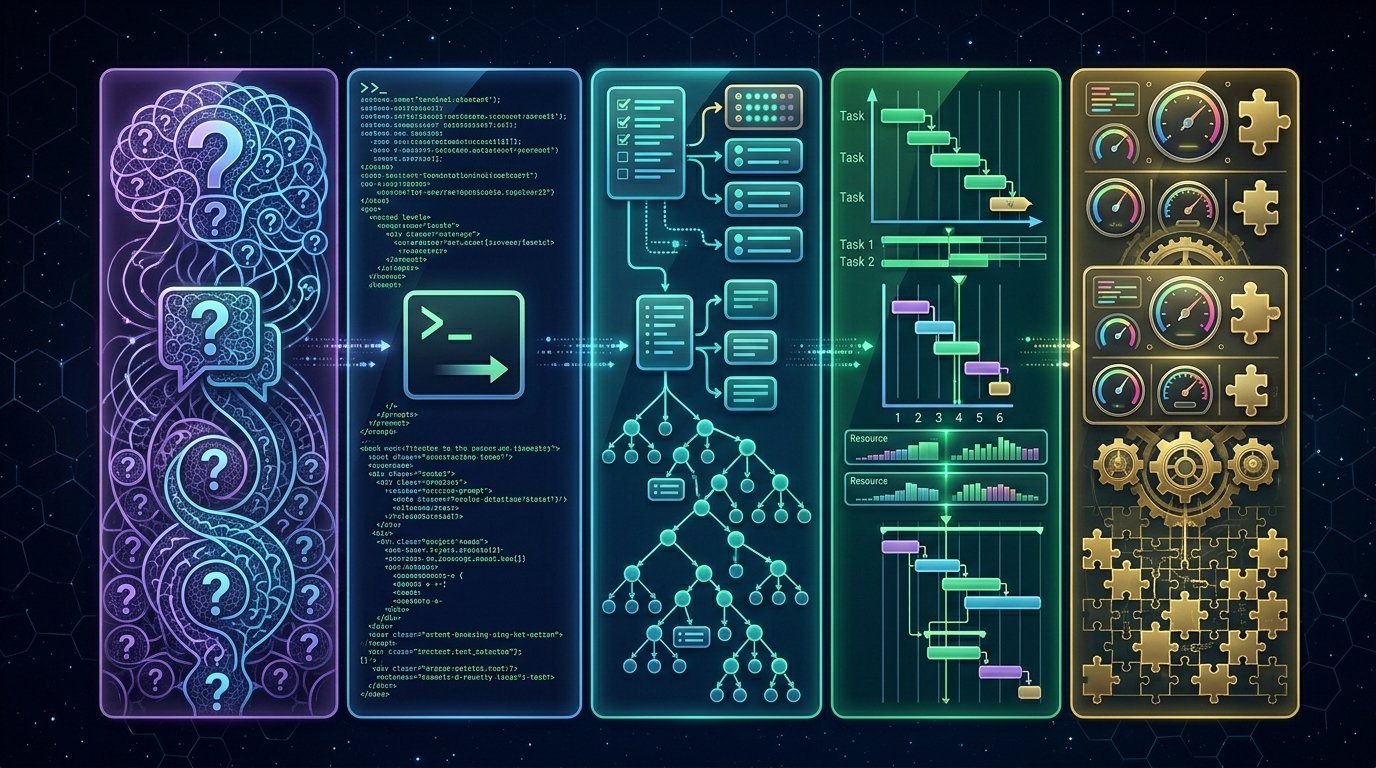
Alex Astrum, Developer Relations for Google Antigravity, argues that prompt engineering has become systems design: the harness around the model, not the model itself, is the primary constraint. He categorizes agent work into five tiers: a simple question (no agent), a task/idea (single zero-shot prompt), an app/feature/story (loops and full-featured agents), a project/epic (loops may help with planning), and a system (AGENTS.md, skills, sidecars, verification gates, instrument cluster). The durable loop matters at the upper tiers.
The article traces the technical lineage: Yao et al.’s ReAct paper (October 2022) interleaved reasoning with tool calls and beat reinforcement learning baselines by 34% on ALFWorld and 10% on WebShop. AutoGPT in early 2023 showed demand for hands-off automation but also the need for structural guardrails. By mid-2025, developers ran stateless bash loops that reset context on every tick, keeping durable state in Git history, progress files, and the test suite. By spring 2026, major tool environments shipped native commands like /goal for unattended loops.
A sequential chain of N independent steps has a cumulative success rate of p^N: a 20-step task with 95% per-step accuracy succeeds only 36% of the time. The fix is a verification gate that spots the error and allows exactly one targeted retry. If the gate detects and fixes errors with 95% accuracy, effective step success becomes 0.95 + (0.05 x 0.95) = 99.75%, yielding roughly 95% end-to-end success at 20 steps and 88% at 50 steps. The gate must be external and independent: compilers, test suites, and linters are free checks; for semantic judgments, pair models from different families. Context also constrains loops: each step adds about 1% of context in tokens, so keeping individual trajectories under 20 steps and dividing complex problems into smaller subproblems with separate evaluations at each level is the recommended topology.
The core guardrails for a durable system are: durable state (Git-backed checkpoints), verification gates (deterministic tests written before implementation, with the rule that agents cannot delete or weaken tests), evals for anything non-deterministic that matters, halt conditions (turn limits around 20 steps, token and cost ceilings), and standardized skills and instructions in SKILL.md and AGENTS.md. Astrum emphasizes that individual model versions last weeks, while the harness—instructions, skills, sandbox, deterministic checks, cross-model review—is the asset that survives releases. When a run fails, patch the harness along with the code so the next run inherits the lesson.
Platforms such as Google Antigravity have codified these patterns as /grill-me and /goal. /grill-me is an interactive interview to lock in design constraints and tests; /goal runs the unattended execution loop. The same harness files travel with the repository across Antigravity 2.0, the agy CLI, and IDE extensions. For custom loops, the article contrasts Geoffrey Huntley’s stateless five-line “Ralph” loop, which is fragile for multi-file coordination, with a Python implementation using the Google Antigravity SDK. That loop initializes a supervisor session, executes a task, verifies with the real test suite, feeds failure output back for exactly one retry, and enforces budgets: max_model_calls=20, max_total_tokens=200_000, max_retries=1. The supervisor and implementer run on Gemini 4 Carbon, codebase search on Gemini 4 Hydrogen, and verification on a deterministic script that costs no tokens. If verification still fails after one retry, the loop returns False and a human takes over. The code is an experimental starting point, not production-ready. Alternatives include Antigravity Agent in an isolated Google Cloud sandbox or running the loop in a long-lived Cloud Run sandbox.
Astrum closes by noting that no loop is valuable unless a responsible human can sign off on the output. Each validation system needs a clear boundary, and the way to build confidence is to observe each loop from inside before stepping one level up.