Anthropic S-1 Analysis: Revenue Growth and $637B Compute Commitments
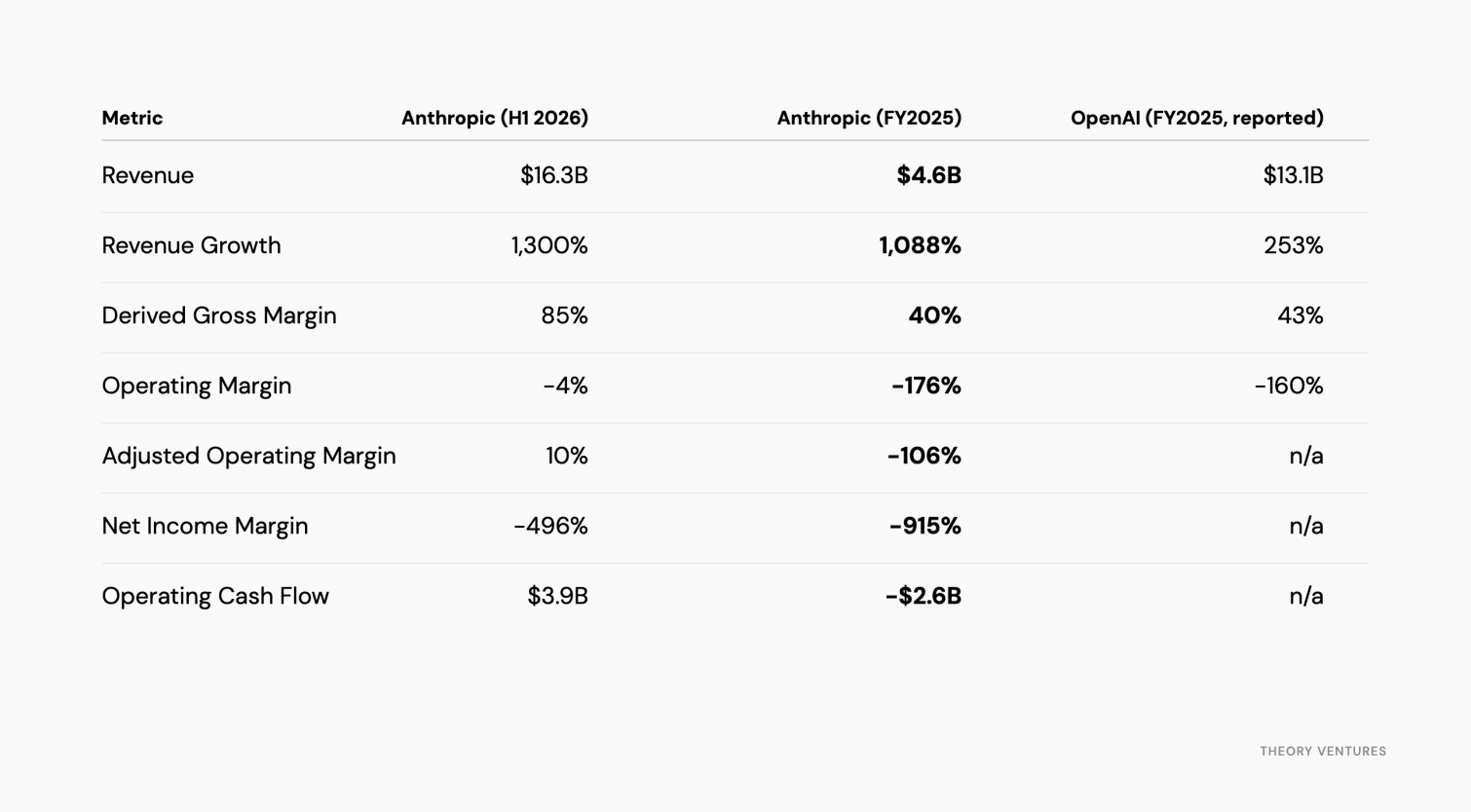
Anthropic has filed its S-1, described as the largest AI listing yet. Founded in 2021 by Dario and Daniela Amodei, the company has become the second-largest model developer, selling Claude to more than 11,900 customers that each spend over $100,000 a year. The filing reveals $16.3B of revenue in the first six months of 2026, a fourteen-fold increase over the $1.2B reported in the first half of 2025. That half-year alone was more than three times all of 2025, when Anthropic grew 11.9-fold to $4.6B—more than four times OpenAI’s 253%. Quarter-over-quarter revenue nearly tripled for two consecutive quarters, with Q2 at $11.6B versus Q1 at $4.7B, continuing three straight years of roughly ten-fold growth: 9.4x, 11.9x, then 14.0x.
The filing ties model efficiency to growth. With Claude Fable 5.1 in September 2026, Anthropic reduced the cost of typical workloads by about 25% versus Fable 5, with savings up to 45% for complex coding and highly agentic tasks. Opus 5.5, released the same month, reduced customers’ cost per task by roughly 40% versus Opus 5. Earlier, Opus 4.5 launched in November 2025 with more capability and a lower cost per task than Opus 4.1, and revenue growth accelerated from 48% quarter over quarter to 132% the following quarter—the filing’s example of Jevons’ paradox.
Anthropic says it is cash-flow positive. Operating loss was $8.1B in 2025, including a $1.5B copyright settlement, but narrowed every quarter of 2026. In Q2, Anthropic reported $974M of operating income, an 8.4% GAAP margin and a 19% adjusted margin.
The leverage sits in compute commitments rather than drawn debt. Anthropic has distributed its computing needs evenly across Broadcom, SpaceXAI, Google and AWS, each holding between $110B and $161B in commitments, together four fifths of the $637B total. The $15B revolver is undrawn, and the only outstanding notes are $6.2B of non-interest-bearing Amazon convertibles. The filing discloses $265.6B of fixed or minimum guarantees at June 30, 2026, plus a further $245B executed since. The source notes these companies are forming a keiretsu, with each entangled in the others’ equity, debt and go-to-market.
Customer concentration has fallen: for the nine months to September 30, 2026, no single customer exceeded 10% of revenue and the top five accounted for about 25%. That contrasts with 2025, when customers spending over $100,000 made up 76% of revenue. Net revenue retention was approximately 900% as of September 30, 2026. Nearly half of Anthropic‘s revenue is now delivered through marketplaces.
The bull case is straightforward: a business that grew 11.9-fold on a 40% derived gross margin and has just begun earning an operating profit. The bear case is the $637B of compute commitments—two thirds non-cancelable—against $4.6B of 2025 revenue, where revenue is consumption-based with no lock-in and the payments arrive whether customers do. The article concludes that the S-1 describes an AI company with an enviable business model, explosive growth and increasing efficiency, and that going from $41M to a $16B half-year in three years is without precedent.


