⭐⭐⭐⭐ 4.0
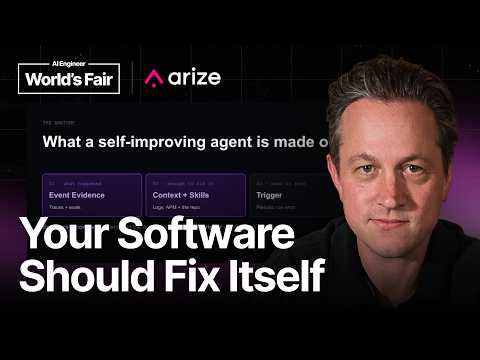
Jason Lopatecki of Arize describes the architecture of Signal, a self-improving agent that inverts the typical debugging loop: instead of waking up to a pager and starting an investigation, you wake up to a pull request that already contains the root cause and a fix. The core unlock is boring and specific: traces on a filesystem. A skill pulls relevant production traces and logs — sometimes ten megabytes of them — into the repo as local files. Coding harnesses like Claude Code work naturally with files but are hopeless with dashboards, so placing traces next to the code gives the agent the exact code path taken, not a guess among a million branches.
From there the agent can produce a real fix. You choose the harness, the sandbox, and the skills. Arize runs inside your VPC because companies like Uber and Booking will not point production systems at an external model. The deeper shift is that observability stops being a dashboard you click and becomes the telemetry a system throws off for agents to read — which is why you now log and trace ten times more, not less.
Lopatecki is honest about the limits: a one-line fix is the easy case; larger fixes still need a human to drive the process. The operator’s job moves from responder to reviewer. The talk includes a demo of Signal, AX, and Phoenix, and a Q&A where he explains why you cannot simply point Claude Code at your raw production data — the agent needs structured traces, not arbitrary access.
Jason Lopatecki of Arize describes the architecture of Signal, a self-improving agent that inverts the typical debugging loop: instead of waking up to a pager and starting an investigation, you wake up to a pull request that already contains the root cause and a fix. The core unlock is boring and specific: traces on a filesystem. A skill pulls relevant production traces and logs — sometimes ten megabytes of them — into the repo as local files. Coding harnesses like Claude Code work naturally with files but are hopeless with dashboards, so placing traces next to the code gives the agent the exact code path taken, not a guess among a million branches.
From there the agent can produce a real fix. You choose the harness, the sandbox, and the skills. Arize runs inside your VPC because companies like Uber and Booking will not point production systems at an external model. The deeper shift is that observability stops being a dashboard you click and becomes the telemetry a system throws off for agents to read — which is why you now log and trace ten times more, not less.
Lopatecki is honest about the limits: a one-line fix is the easy case; larger fixes still need a human to drive the process. The operator’s job moves from responder to reviewer. The talk includes a demo of Signal, AX, and Phoenix, and a Q&A where he explains why you cannot simply point Claude Code at your raw production data — the agent needs structured traces, not arbitrary access.