AI Comes for the If Statement
Software has always been a way of encoding rules and exceptions: if the food is a banana, send it to produce; if it is a cookie, the snack aisle; if it is cumin, the spice shelf. Real-world operations quickly accumulate exceptions — spoiled bananas, crumbled cookies, caked cumin, a plantain that looks like a banana, Dubai chocolate that could be dessert or baking supply. Traditional pre-AI programs handle these as rigid logic, while AI is expected to absorb the ambiguity. But the article argues that the newest wave of AI is best understood not as a general reasoning engine but as a robust if-then decider.
The centerpiece is the observation that simple classification tasks do not need the world’s most brilliant model. Systems called Jev2 and SemIf answer questions like “is this a plantain or a banana?” in hundreds of milliseconds at a 99% reduction in cost compared to traditional AI. They simplify existing models by running the attention math once and then computing the probability of each allowed answer from a few output tokens. In other words, instead of generating a full response, they narrow the model’s work to choosing among a predefined set of possibilities.
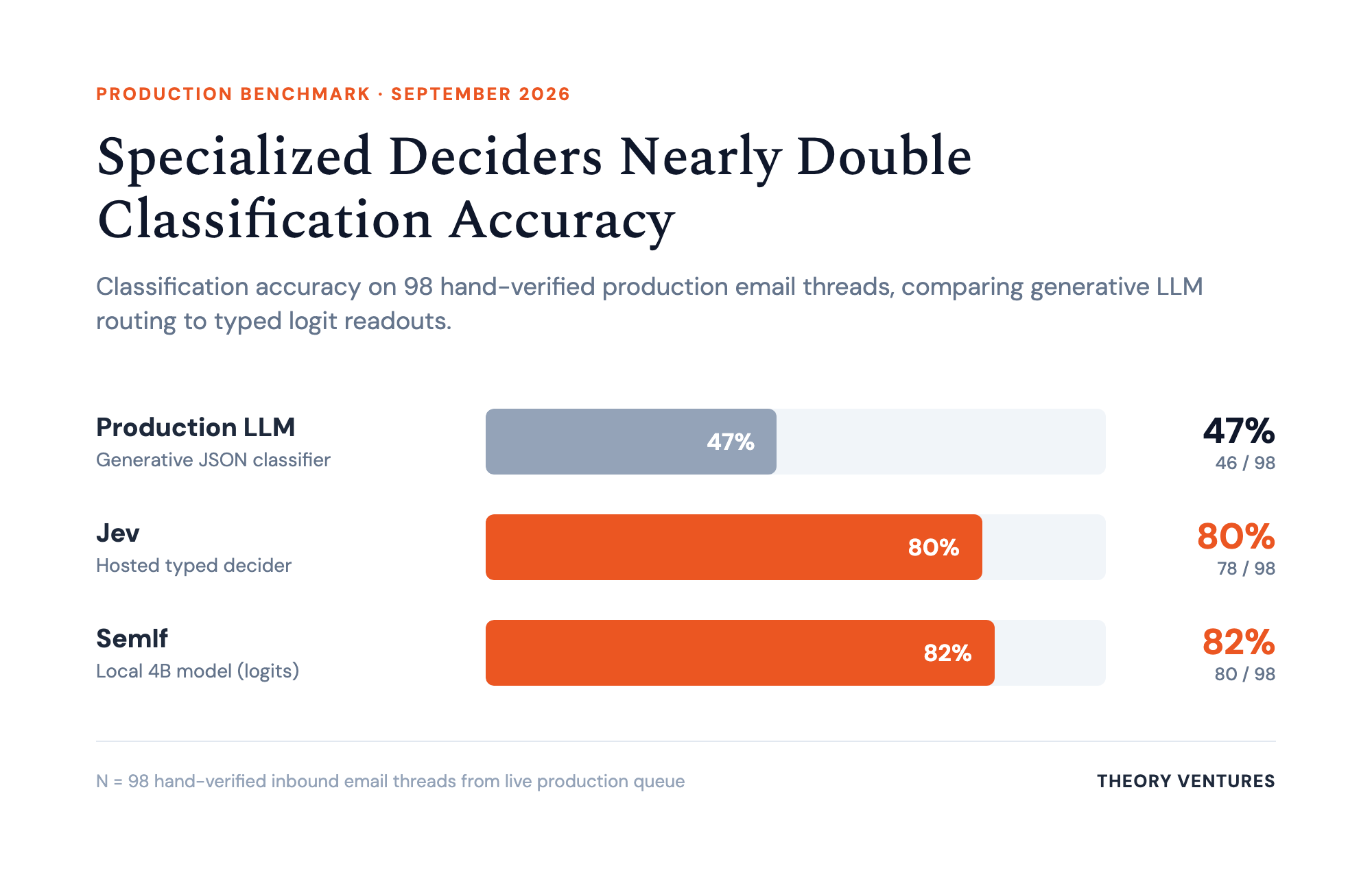
The author then looked for if-then statements in their own code that had been handed to AI. Within a few minutes, they replaced about a quarter of those calls in one of their agents. On 98 hand-verified production email threads, the specialized deciders nearly doubled classification accuracy compared to the production model, jumping from 47% to over 80%. This is presented as a concrete example of optimizing a single programming primitive: the if-then statement. Doing so produced nearly two orders of magnitude in cost reduction alongside higher accuracy, a combination that is unusual in AI work.
The article ends with two broader implications. First, if this pattern holds, other programming primitives may benefit from the same kind of specialization. Second, it highlights a bifurcation in AI economics: large frontier models remain valuable for discovery, training new models, and architecting systems, but once a system is engineered and hardened, running it thousands or millions of times through a workflow benefits from narrower, cheaper, more accurate models. The author suggests that if this is the first of many primitives specialized for production, then AI harnesses — the surrounding software infrastructure that wraps models into applications — are about to capture a lot more margin.
The piece is deliberately practical rather than theoretical. It does not claim that specialized deciders replace frontier models or that all AI workloads should be converted to if-then classification. The evidence is limited to one agent, one set of production email threads, and two named systems, so the results are suggestive rather than general. The core argument is that the if-then statement, one of the oldest and simplest programming primitives, is now being reimplemented as a specialized AI service, and that this kind of targeted optimization may reshape how production AI is built and priced.