⭐⭐⭐⭐✨ 4.5
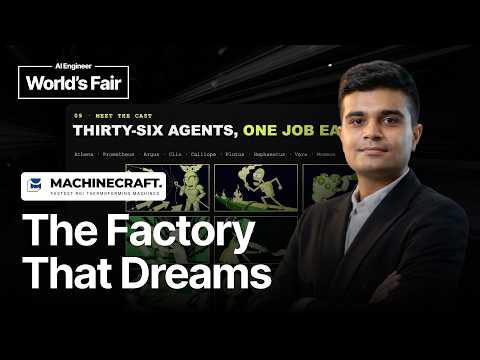
Rushabh Doshi shared the complete story of building Ira, a multi-agent operating system for Machinecraft, a three-generation family-owned mechanical manufacturing company in India.
The core question: How can a traditional manufacturing company, without relying on any existing frameworks, build a truly functioning “company brain” using 39 agents and a self-developed architecture?
He explicitly opposes the common “toy workflows” and generic AI assistant approaches seen in current AI demos, arguing that what enterprises need is not another SaaS dashboard, but a digital brain rooted in their own documents, relationships, processes, and values.
Three key takeaways: First, Rushabh explicitly opposes using any off-the-shelf agent frameworks, believing they are too abstract and unable to adapt to the complex, nonlinear request flows of real business.
Ira‘s core is a 17-stage request pipeline, routed by an orchestration agent named Athena, which distributes tasks to 39 specialized agents with clear boundaries.
Second, he proposed the concept of a “digestive system”: Ira does not simply retrieve files; instead, through a process similar to biological digestion, it breaks down, classifies, embeds, and stores company documents (PDFs, emails, chat records) into Qdrant and Neo4j, building a relational knowledge graph.
Third, he emphasized an “immune system” guardrail mechanism, where each agent’s output is validated to prevent hallucinations and misinformation spread, while using Mem0 for long-term semantic memory, and performing knowledge integration and correction through nightly “dream” cycles.
The most notable trend to follow is Rushabh’s “Fork My Brain” concept: He believes the right way to build enterprise AI is not to sell another SaaS dashboard, but to send a special AI team into the company for a week, map the business from the inside, ingest key documents into Qdrant and Neo4j, connect operational databases, and finally leave behind a replicable digital brain.
This “embedded, forkable” delivery model, if proven effective, could fundamentally change how enterprise AI is deployed—from selling tools to selling “brain transplant surgery.
” Additionally, Ira has a philosophical constitution called SOUL.md, based on Jain principles such as Anekantavada (non-absolutism) and Svadharma (personal duty) to constrain agent behavior.
This approach of encoding ethics directly into the system architecture is worth referencing for any team building autonomous agents.
Rushabh Doshi shared the complete story of building Ira, a multi-agent operating system for Machinecraft, a three-generation family-owned mechanical manufacturing company in India.
The core question: How can a traditional manufacturing company, without relying on any existing frameworks, build a truly functioning “company brain” using 39 agents and a self-developed architecture?
He explicitly opposes the common “toy workflows” and generic AI assistant approaches seen in current AI demos, arguing that what enterprises need is not another SaaS dashboard, but a digital brain rooted in their own documents, relationships, processes, and values.
Three key takeaways: First, Rushabh explicitly opposes using any off-the-shelf agent frameworks, believing they are too abstract and unable to adapt to the complex, nonlinear request flows of real business.
Ira‘s core is a 17-stage request pipeline, routed by an orchestration agent named Athena, which distributes tasks to 39 specialized agents with clear boundaries.
Second, he proposed the concept of a “digestive system”: Ira does not simply retrieve files; instead, through a process similar to biological digestion, it breaks down, classifies, embeds, and stores company documents (PDFs, emails, chat records) into Qdrant and Neo4j, building a relational knowledge graph.
Third, he emphasized an “immune system” guardrail mechanism, where each agent’s output is validated to prevent hallucinations and misinformation spread, while using Mem0 for long-term semantic memory, and performing knowledge integration and correction through nightly “dream” cycles.
The most notable trend to follow is Rushabh’s “Fork My Brain” concept: He believes the right way to build enterprise AI is not to sell another SaaS dashboard, but to send a special AI team into the company for a week, map the business from the inside, ingest key documents into Qdrant and Neo4j, connect operational databases, and finally leave behind a replicable digital brain.
This “embedded, forkable” delivery model, if proven effective, could fundamentally change how enterprise AI is deployed—from selling tools to selling “brain transplant surgery.
” Additionally, Ira has a philosophical constitution called SOUL.md, based on Jain principles such as Anekantavada (non-absolutism) and Svadharma (personal duty) to constrain agent behavior.
This approach of encoding ethics directly into the system architecture is worth referencing for any team building autonomous agents.