Strategic Pricing or Structural Cost? Anthropic vs OpenAI Tier Split
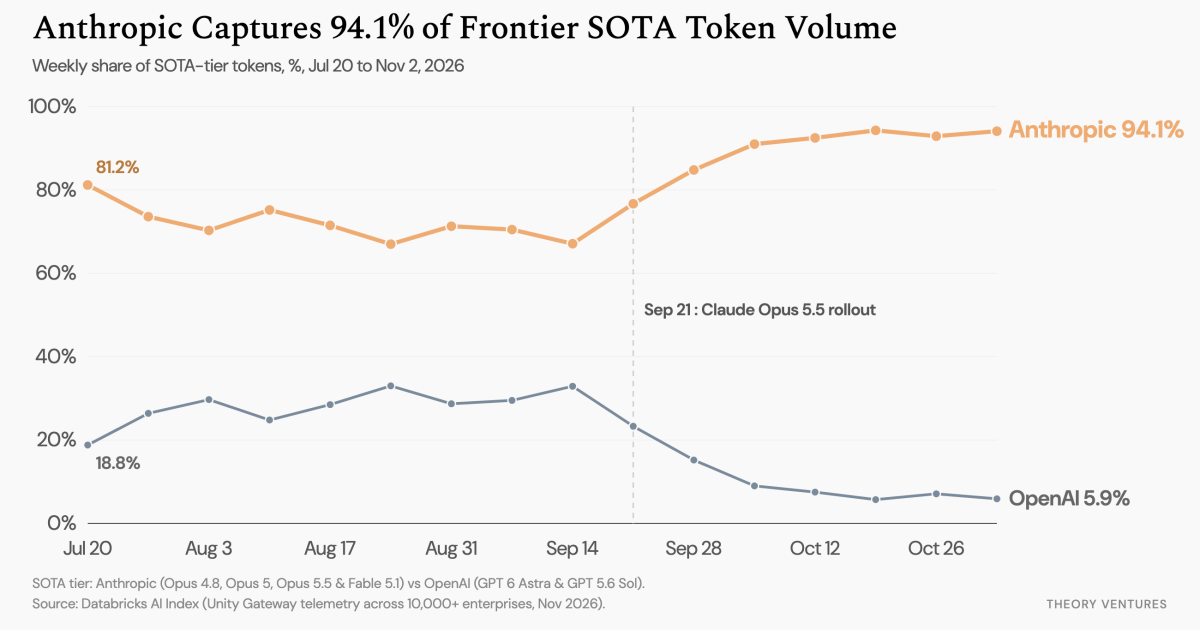
Sixteen weeks of Databricks Unity Gateway telemetry across more than 10,000 enterprises shows Anthropic and OpenAI splitting the AI model market by tier rather than competing head-on in one segment. Anthropic holds 94% of frontier state-of-the-art (SOTA) token volume and 70% of proprietary spend, while OpenAI holds 81% of low-end token volume. Each lab therefore ends up with roughly 90% share of an AI segment, but the segments are different: Anthropic dominates the premium end, OpenAI the high-volume low end.
The question this split raises is whether it reflects a deliberate pricing strategy to capture different ends of the market or a structural cost difference in how the two labs serve tokens. The telemetry supports the tier view but leaves the underlying cause open.
Anthropic‘s premium position has strengthened over the sixteen weeks. Its share of SOTA token volume rose from 81% in July to 94% on November 2, propelled by the September 21 rollout of Claude Opus 5.5.1. The mid tier is where the two labs now collide directly. Across all Sonnet and Sol versions—Sonnet 5 and 5.5 versus GPT-6 Sol and 6.1 Sol—OpenAI climbed from 0% in July to 47% of mid-tier volume by November 2. In the newest cohort, OpenAI took 57% of Sonnet 5.5 versus Sol 6/6.1 volume within six weeks of launch.
OpenAI‘s low-end position was built on aggressive price cuts for GPT-6 Luna. On July 30, OpenAI cut Luna pricing by 80%, then cut it another 50% a few months later, for a combined 90% reduction. GPT-6 Luna launched on September 22 at $0.10 per 1 million tokens. After the first cut, OpenAI‘s low-end share jumped from 30% to 66%, peaked at 84%, and finished at 81% on November 2. The pricing pressure also coincides with a stall in the open-weight segment: open-weight token share climbed every week from 7% in July to 33% in September, then stalled at 31% in the same week GPT-6 Luna and Sol cut prices by 50%.
The strategic question the piece highlights is whether Luna’s pricing is a short-term market-share subsidy or a structural cost advantage in OpenAI‘s model architecture. The data shows the tier split and the price-cut timing, but it does not by itself distinguish between a deliberate market-capture strategy and an underlying cost advantage.