HiRO-ACEv2: AI Climate Emulator Generates 3 km Data at Fraction of Cost
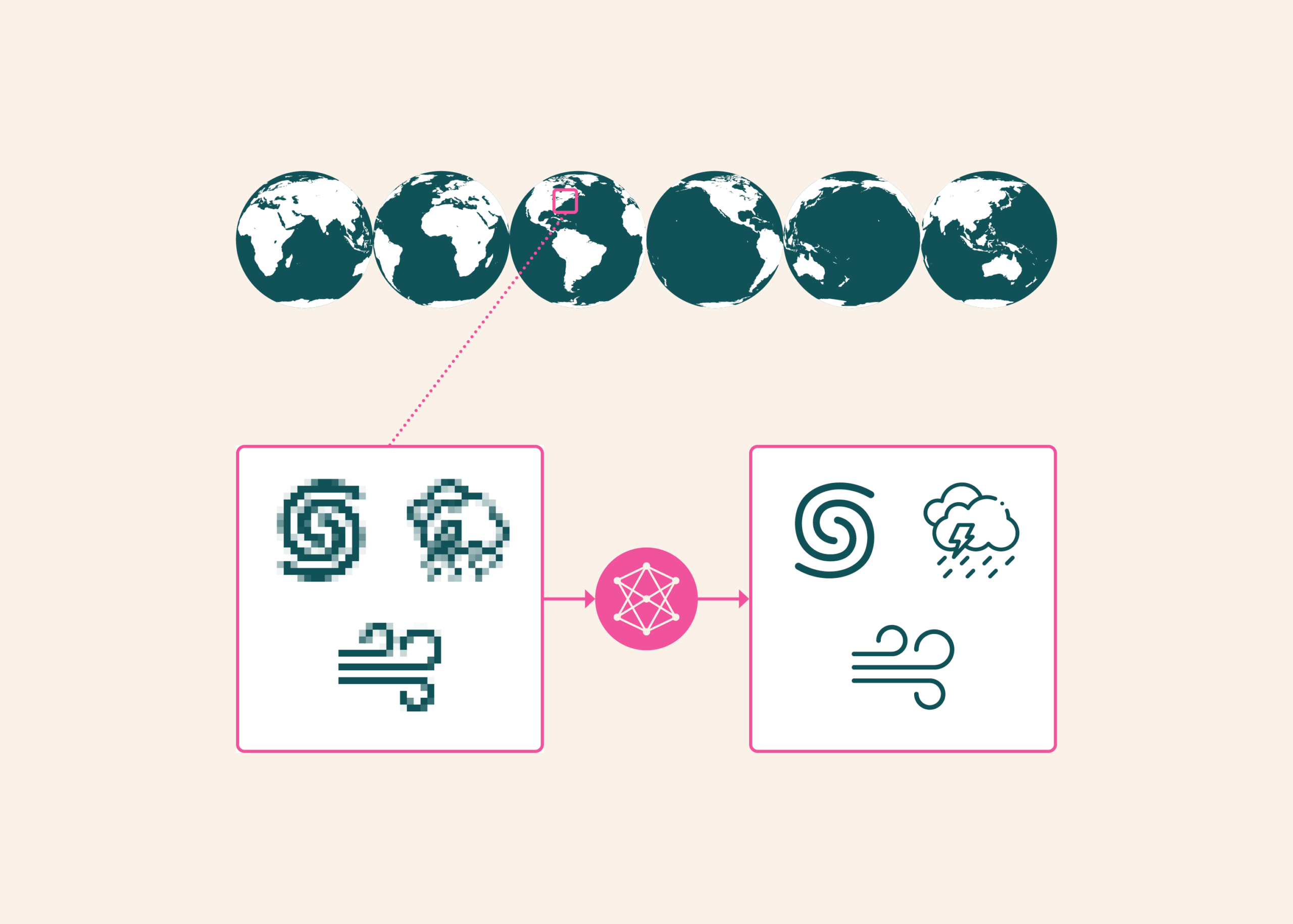
HiRO-ACEv2 is the newest update to the High Resolution Output Ai2 Climate Emulator (HiRO-ACE). The system combines ACE, an AI model that runs at 100 km resolution, with HiRO, a downscaling model that sharpens coarse outputs to 3 km detail. According to the authors, HiRO-ACEv2 can reproduce very rare rain, wind, and pressure events with high accuracy, and generating global 3 km climate data costs roughly 1/300th as much as running X-SHiELD, a high-resolution global atmospheric model that explicitly simulates storms and small-scale weather.
The main change is the new downscaling model HiROv2. It predicts several high-resolution fields at once rather than only rainfall, and it is better at capturing extreme events. When given coarsened X-SHiELD data, HiROv2 matches the target simulation’s high-resolution statistics to within 3%, even for events that occur only once in a million data points. It accurately estimates the total energy of tropical cyclones, including storms not seen during training, and generates hurricanes with realistic eyes and rain bands, though winds and pressure around the eye remain somewhat more lopsided than in X-SHiELD. It also realistically generates strong winds flowing down mountain slopes.
An updated version of ACE was trained for the system. Over a 10-year simulation, its hurricanes, average climate patterns, and overall distributions of rain, wind, and pressure line up well with X-SHiELD, indicating that ACE‘s coarse simulations provide a solid foundation for long-term high-resolution climate data. Combining HiROv2 with ACE, the team generated a full year of global 3 km data whose statistics closely match X-SHiELD, even though HiRO was working from a simulation ACE ran on its own rather than from real X-SHiELD data. Across a 10-year run, the energy of HiRO-ACEv2‘s hurricanes is comparable to X-SHiELD‘s, and snapshots show a variety of other extreme events resembling those in X-SHiELD.
The system is intended as a flexible, inexpensive way to generate many versions of high-resolution rain, wind, and pressure data for extreme events over 10 years or more. Global high-resolution output costs about 300 times less than running X-SHiELD; if only one region is needed, the savings can be more than a hundred times greater depending on the area. A streamlined version of HiROv2 is being developed that could be more than ten times faster still.
There are stated limitations. Because HiRO learned from X-SHiELD, it only works with the version of ACE tuned to match X-SHiELD; it cannot yet produce high-resolution data for other climates, such as a warmer future or the historical record in datasets like ERA5. The authors plan to train on new X-SHiELD datasets, including one simulating a world 4°C warmer, and to add outputs like near-surface temperature and snow and ice, which would support uses such as snowpack prediction.
For practical use, a web demo shows pre-generated precipitation, wind, and sea-level pressure output from HiROv1 and HiROv2 side by side with X-SHiELD, letting users zoom in on regions of interest. The models are available for download, and tutorial notebooks explain how to run them.