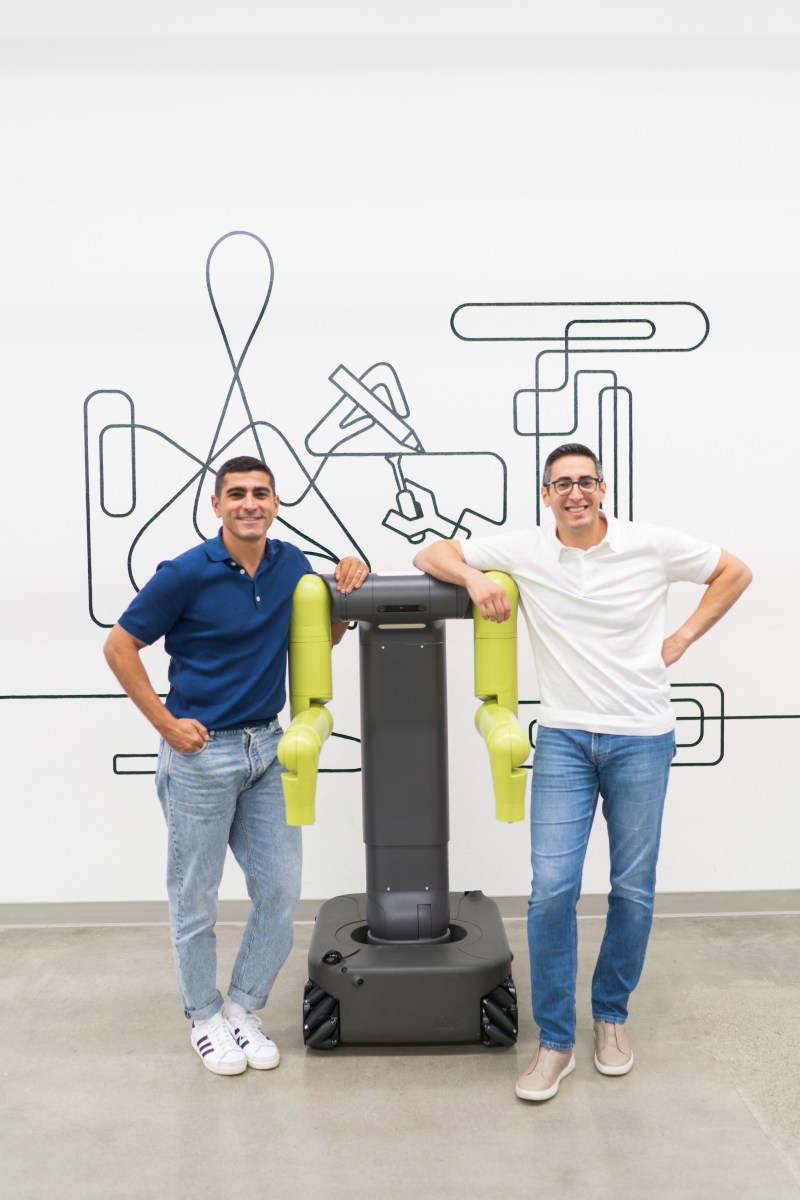
Maven Robotics exits stealth with $100M for end-to-end warehouse automation
Maven Robotics is emerging from stealth with $100 million in funding and a claim that it can win robot deployment deals by solving whole warehouse workflows rather than single robot tasks. CEO and co-founder Hamza Derbas, who spent nine years at Apple’s special project group before starting the company with his brother Khalid in 2024, describes the company’s origin as a bet on industrial realism: when a large consumer goods company came to town to meet four rival robot companies, Maven—then just “a cartoon of a robot and a team of people”—talked its way into the meeting, skipped the robot pitch, and asked to visit the company’s factories and warehouses. Derbas says the team zeroed in on flows where they could immediately add value and showed that their approach hooks into a warehouse management system on one side and places product onto trucks on the other, handling the task end to end rather than solving a single robot problem. That approach won the deal, beating companies that already had robots.
The robots themselves sit on wheeled bases, can move at 10 miles an hour, and have two arms that lift up to 30 kilograms. Their current focus is “mixed palletizing”: wooden pallets of boxed goods arrive from different factories at a distribution center, and the robot builds new pallets containing a mix of goods destined for a specific store, based on real-time demand. Derbas points out that within 48 hours of products reaching shelves, retailers want to change the mix, and that today this work is done by humans running around the warehouse picking one of this and one of that. Maven’s robots are trained in a facility in Santa Clara, where a live video screen shows two robots working in a customer facility while employees walk around them. According to Derbas, after two years of work with the initial customer and a few other partners, Maven has up to eight robots operating 16 hours a day with 99% or higher uptime. The company plans to build 250 of its third-generation robots and begin design on a fourth-generation platform.
Derbas frames Maven as part of the physical AI wave, relying on veterans of self-driving car efforts who have developed sophisticated approaches to training autonomous hardware from real data. The key operational loop is tight: data pipelines return information from operating robots within minutes or hours, then the team retrains, evaluates, runs ablation studies, determines the right set of weights, redeploys, and turns the loop again. Investor Jack Pearson of RoboStrategy, which backed the company, says Maven stands out because of its background in industrial systems rather than a research culture optimized for learning or focused on a specific architecture. The company is explicitly not competing on frontier models. “We’re not in the race for models—we’re in the race to solve industrial labor and make this work possible at the scale the world needs,” Derbas told TechCrunch.
Maven’s positioning is deliberately critical of flashier approaches. Derbas contrasts the company with Agility Robotics, which is going public in a $2.5 billion SPAC deal and is the most similarly positioned firm in the market, focused on safety and specific industrial workflows. But Agility’s robots stand on two legs, which Derbas—while stressing his respect for the company—says “make zero sense for anything they’re doing…they are very complex, unreliable, and add unnecessary cost. ROI is the name of the game here.” The source notes that this understanding of overheated facilities and the needs of the people who operate them has gotten Maven out the door, but that expanding beyond current workflows will require some kind of research culture.
The company’s roadmap is task-by-task rather than general-purpose in one leap. Derbas says Maven is “grounded in solving one customer problem at a time,” and that if you pick sizeable problems, each one is a multi-billion-dollar market with enough data to master the skill. While palletization might be an $80 billion market, the next set of tasks Maven targets will require robotic manipulation capabilities that don’t yet exist. The company’s next big push is to collect more data and train robots to handle materials, then move toward automation and fabrication. It will draw on its own systems, tap third-party providers, and has already developed a pair of pincer-like gloves that let humans emulate the form factor the company wants for its grippers. The source also notes a risk: this process might be the most viable path to putting robots in the workplace, or an opportunity to be “one-shotted by the next powerful physical AI model to roll out of the frontier labs.”