AI Productivity Doesn’t Mean What I Think It Means
The author reflects on two years spent pushing AI writing tools from mechanical automation to genuine creative partnership.
Early attempts using prompt templates, fine-tuned models, elaborate system instructions, and multi-agent debate pipelines all produced bland prose because they treated writing as one-shot generation.
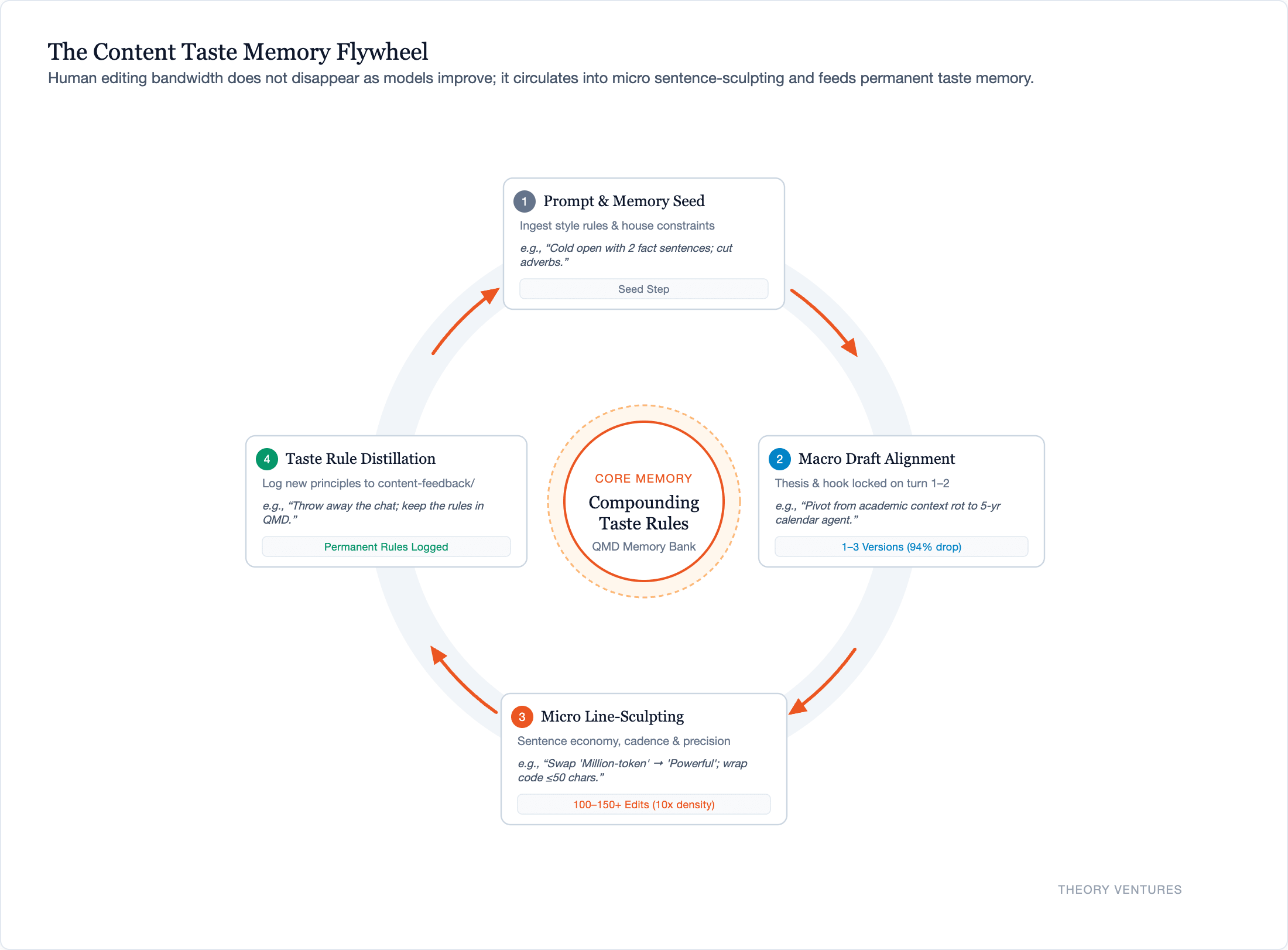
The architecture that finally worked was a closed-loop taste flywheel: before drafting, the agent ingests background research alongside a local memory bank of learned house rules; it produces a draft in seconds, captures every human critique during review, and logs those lessons back into permanent files for the next essay.
Contrary to the common assumption that human edits would fall toward zero as the AI improved, data across ten published essays showed the opposite.
Drafting a data-heavy post required 47 draft revisions early on, while a later essay on agent lifespans took only 3 drafts.
Yet granular sentence edits remained flat at roughly 130 per post, hovering around an average of 140 edits per piece.
The time savings redirected human attention upward: early structural triage (reorganizing arguments, fixing narrative spines) collapsed once local taste memory stabilized, while line-level craftsmanship absorbed more focus.
The ratio of granular edits per draft version surged from 4.4 to 43.3. The author draws a parallel to chess evolution.
When engines arrived, many assumed human chess would stagnate, but the data shows the opposite.
The number of grandmasters grew from 524 in 1993 to roughly 1,750 today; the pool of elite talent expanded more than threefold.
Studying became faster—what once required two weeks of gathering and a month of preparation now takes half an hour in a database.
The same or fewer hours produced a far higher ceiling of skill because the tool itself improved. The efficiency gain redirected the work into a higher ceiling, not into zero effort.
The author argues this is the Jevons Paradox in action: increasing the efficiency of a resource increases its consumption.
For writing, the mechanical work collapses, and the discretionary effort moves up the value chain—from fixing broken spines to sharpening sentence rhythm, stripping adverbs, and cutting decorative clauses.
The measure of a mature agent harness is not elimination of human edits but elevating the writer from a structural mechanic to a sharpshooter.
The question is whether we accept the pre-AI baseline or push for the higher-quality output now possible.