Revenue per Megawatt and the AI Model Factory
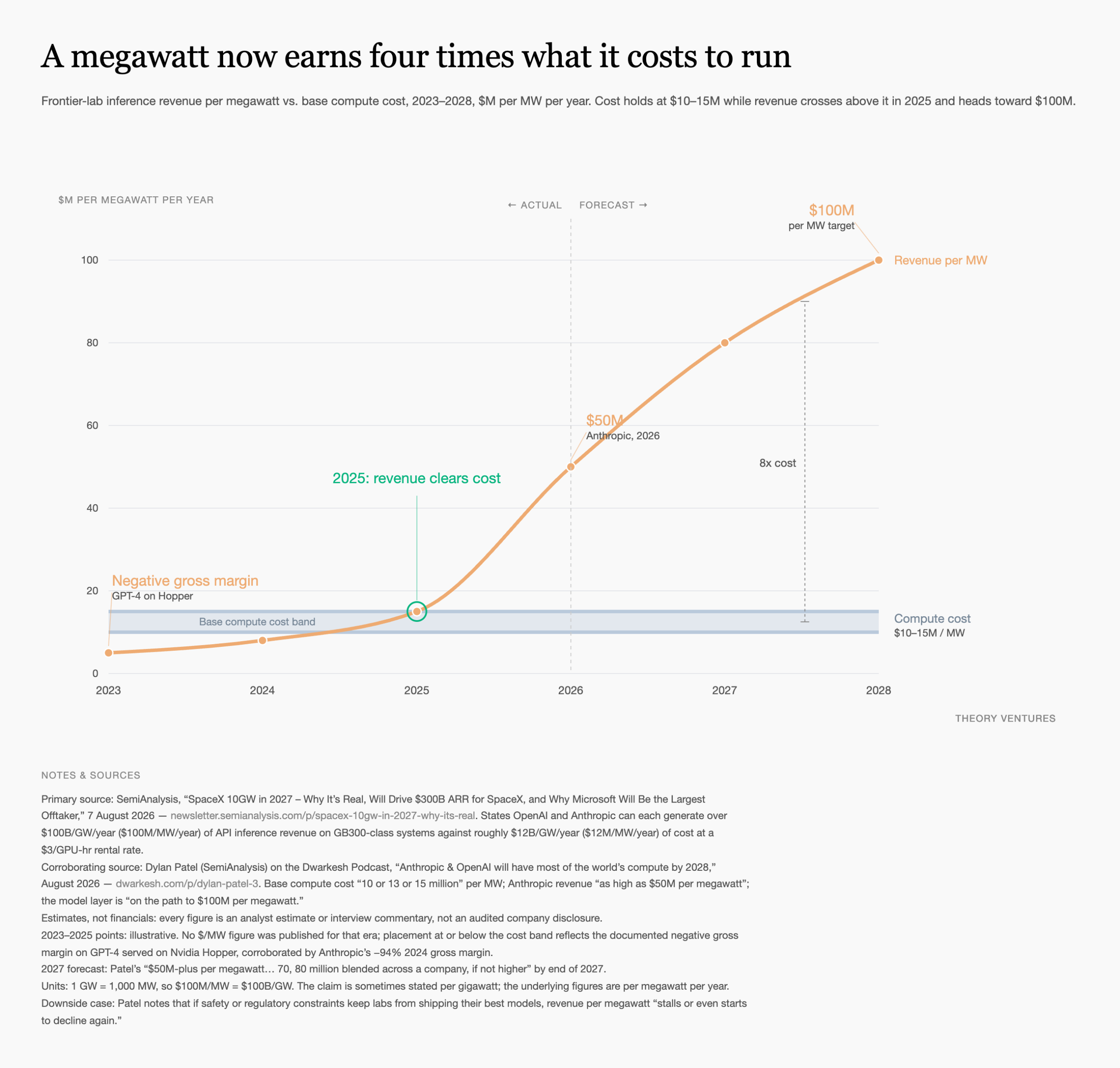
An AI model company buys wholesale electricity by the megawatt and resells it as cognitive work. Dylan Patel of SemiAnalysis notes that the base cost of compute runs $10–15 million per megawatt, while Anthropic has generated up to $50 million per megawatt in revenue. This implies that every $10 spent on inference capacity yields $50 of revenue, creating a reinvestment loop. Gross margin as a function of electricity demonstrates that model companies can be profitable on a contribution basis.
Anthropic‘s gross margin was −94% in 2024, meaning $1.94 of compute cost for every $1 of revenue. By 2025 the corner turned, swinging from −94% to a 40–50% gross margin. In 2026, revenue passed cost: $50 million per megawatt against a $10–15 million cost. Anthropic booked its first profitable quarter with $10.9 billion of revenue and $559 million of operating profit. That 5% operating margin sits well below the 70–80% gross margin the megawatt math implies; training runs and headcount consume the difference.
Gross profit per megawatt depends not just on intelligence but also on efficiency. A model delivering the same intelligence at a fraction of the compute generates more profit per megawatt, even at a lower price. For example, GLM-5.3-Flash scores 57 on the Artificial Analysis Intelligence Index — identical to Claude Opus 4.8 — but uses 18 billion active parameters at a 90–97% reduction in cost. Fewer active parameters and less attention compute mean more tokens per megawatt. However, the frontier keeps climbing: three jumps of 3 points or more carry half of the 25-point gain from 37 to 63. Efficient models chase a target that resets every quarter.
Patel’s key point is that the profit per megawatt is reinvested entirely into training. This margin funds the factory. Nvidia paid $6 billion to acquire Poolside and invested another $1 billion on that premise. Model building becomes an industrial process: thousands of experiments across a search space, not artisanal hand-tuning. As Jason Warner of Poolside puts it, ‘The model is the output. The ability to keep building better models, faster & more efficiently each time is the actual innovation. The Model Factory is the compounding asset.’ Laguna S 2.1 went from kickoff to release in 52 days. Inference margin funds the factory that makes the next model cheaper to build and more efficient to run.