Previously Unmanufacturable: When English Becomes the Software Interface
Every software product has its own grammar. Figma speaks in layers and components, Salesforce in accounts, contacts, and opportunities, CAD in splines and constraints. Learning that grammar takes time, and the relationship between power and expertise runs in one direction: the more powerful the software, the more expertise it demands, no matter what a product manager intends. Usability labs have traditionally tried to close this gap one user at a time. AI closes it differently, the article argues, by making English the interface itself. A person describes the outcome, and an agent translates that intent into “computerese.” Programmers were the first to experience this through what the article calls AI’s babelfish — from English into C++, Rust, and TypeScript. Increasingly, the languages worth translating are those of the application layer: accounts, purchase orders, circles, and splines. English, the article claims, is becoming a universal API.
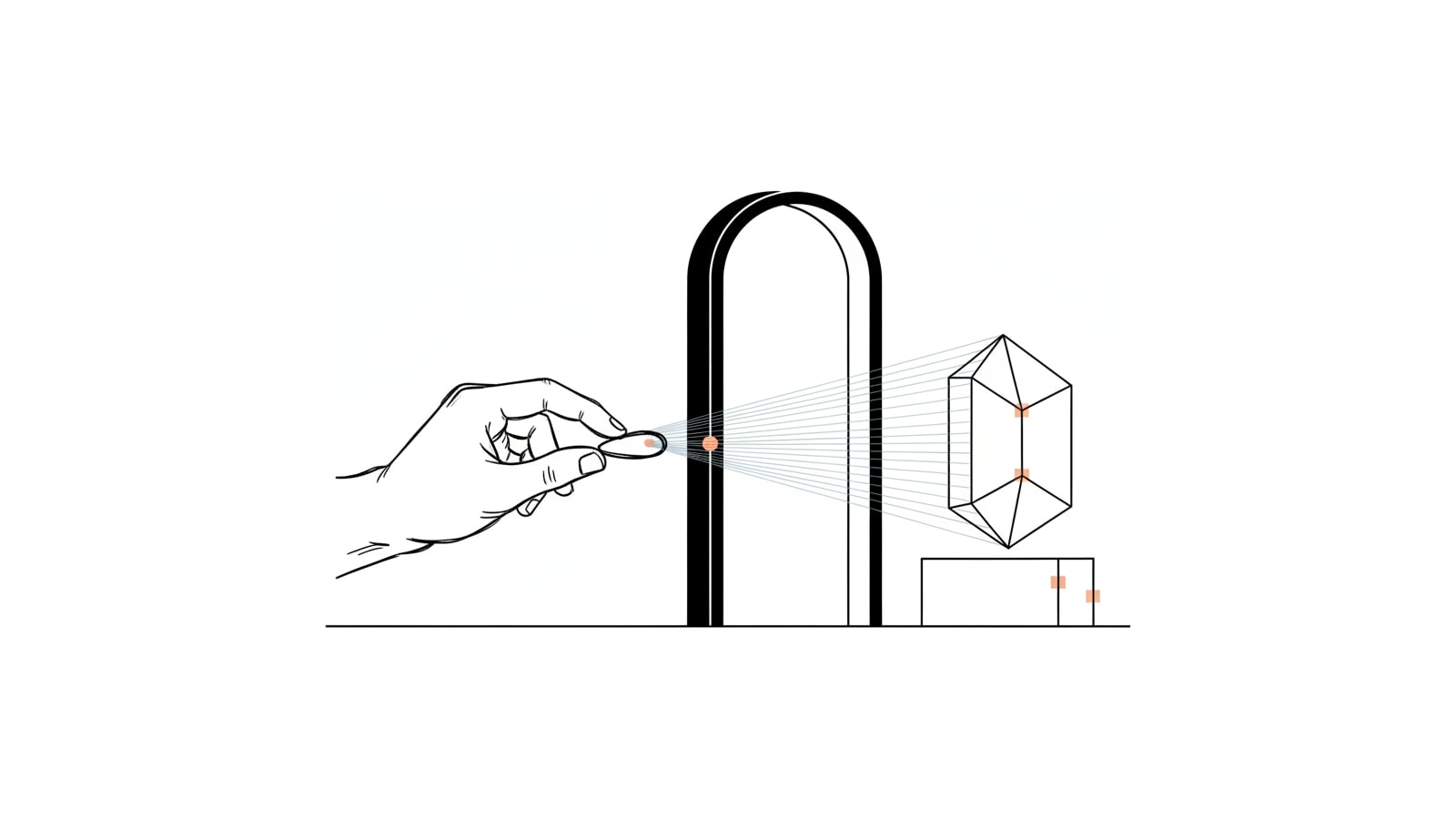
The supporting example is Yana Welinder, a non-technical founder who directed Codex to drive CAD software on her behalf. Inspired by Ruth Asawa’s looped-wire sculptures, she wanted a garment that was previously “unmanufacturable.” She asked AI to use software she could not operate herself, and the result the article calls spectacular. The point is direct: if AI can translate intent into CAD’s grammar, it can do the same for any software’s grammar. That inverts product design. Software built for people has tended to favor simplicity, jump-in-and-try behavior, and little need for documentation. Software built for AI, by contrast, can be complex and well-documented, because an agent can hold, retrieve, and reason about more of a system’s schema at once than a human clicking through menus. The product manager’s job shifts from designing every screen to building the harness that lets an agent act on the system safely, completely, and without being shown anything.
The same shift makes documentation more important, not less. Infrastructure has always relied on detailed documentation because developers need to understand APIs, schemas, and failure modes before trusting a system. That requirement is now moving up the stack into applications. The old UX lab evolves into evaluations: watching how an agent operates software, rather than watching only how a person reacts. This is especially relevant for product-led growth companies that sell themselves without a sales team and for forward-deployed engineering products, because both depend on reducing onboarding friction.
Nevertheless, the expert does not disappear. Software engineering’s current renaissance has already replaced syntax editing with systems architecture: the hard problems, the ones that affect how pieces fit together, still require someone who understands the system underneath. The article applies the same logic to the CAD example. Agents can operate CAD, but the difficult underlying work still requires depth in the systems where depth is the job. And to achieve end-user simplicity, software must expose a greater complexity to agents.
The article closes with Dieter Rams’s design philosophy: start from the premise that everything is noise, then earn the right to keep only what is essential. English lets a user do the same with software — say what matters and let the agent absorb the rest. The dress Yana Welinder made becomes a concrete demonstration of that abstraction, and the closing question is what Rams would design in the new AI era.