LFM2.5-VL-3B: On-Device Vision-Language Model with Fast Inference
Liquid AI released LFM2.5-VL-3B, a 3.1B-parameter vision-language model designed for on-device and edge deployment. It extends the company’s previous LFM2.5 text model with vision capabilities, pairing a SigLIP2 400M NaFlex vision encoder with the same pre-trained backbone used in LFM2.5-2.6B. The model was pre-trained on about 34 trillion tokens, with four times more vision data than prior releases, sourced from curated and synthetic image-caption, OCR, grounding, and instruction-following datasets. The tokenizer was extended to 128K tokens to support non-Latin scripts without retraining from scratch.
Post-training uses two stages: supervised fine-tuning with knowledge distillation from a larger teacher and Antidoom training, followed by multi-reward reinforcement learning. The model is designed to answer directly without intermediate reasoning, keeping responses fast for real-time applications.
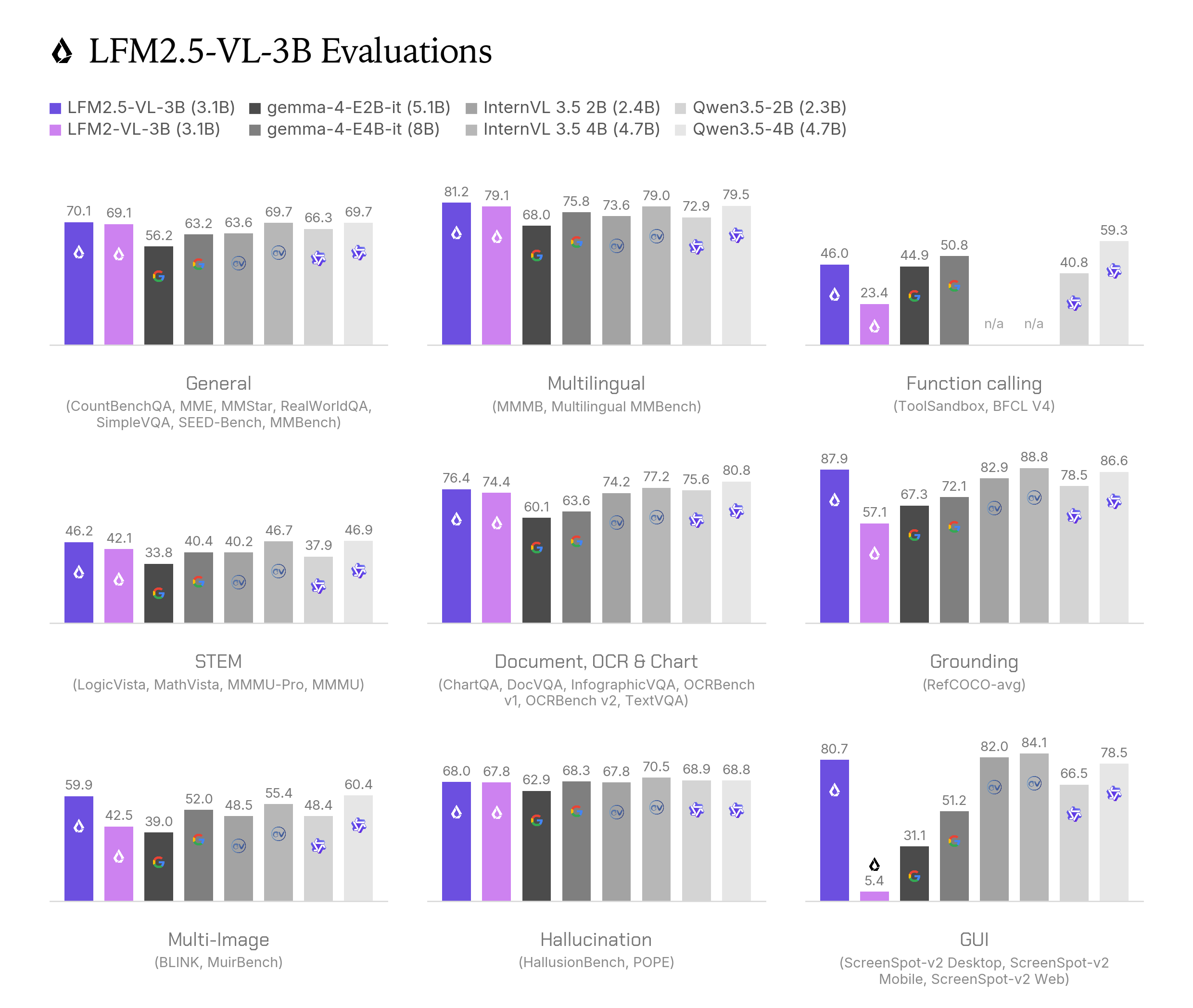
LFM2.5-VL-3B achieves strong benchmark results across general vision tasks, multilingual understanding, document and screen reading, grounding, multi-image reasoning, and tool use. On average across 28 vision benchmarks, it scores 69.4, outperforming its predecessor LFM2-VL-3B (57.2), Gemma-4-E2B-it (52.0), Gemma-4-E4B-it (59.7), InternVL 3.5 2B (64.6), InternVL 3.5 4B (69.4), Qwen3.5-2B (63.7), and Qwen3.5-4B (70.1). It leads on several real-world image tasks, including MMStar (63.3), RealWorldQA (73.1), MMBench (81.0), ChartQA (81.3), DocVQA (91.1), TextVQA (84.3), and ScreenSpot-v2 for desktop (78.7), mobile (81.2), and web (82.2). On the grounding benchmark RefCOCO-avg, it scores 87.9, far ahead of the previous 3B model (57.1).
On text-only benchmarks, instruction following improves sharply: IFEval 82.3, IFBench 25.8, Multi-IF 59.4. Tool use and function calling also improve significantly: ToolSandbox 59.5, BFCL V4 32.5. On tool use, LFM2.5-VL-3B is on par with Gemma-4-E2B and Qwen3.5-2B.
Inference speed is a key focus. The model achieves 228 tokens/s on an M5 Max, 116 tokens/s on a Ryzen AI Max+ 395, and 20 tokens/s on a Galaxy S26 Ultra, fitting in about 3 GB of memory. On GPU, it reaches about 11,000 tokens/s at high concurrency, roughly 2x the throughput of larger 4B-class models and ahead of smaller 2B-class models, translating to nearly 1 billion output tokens per day on a single H100. It supports day-one inference across llama.cpp, MLX, vLLM, SGLang, and ONNX.
Usage is straightforward with the Hugging Face transformers library (version >=5.10.1). The model is available on Hugging Face, with a WebGPU demo, and fine-tuning tutorials. The article explicitly states the model is designed for on-device intelligence for high-volume workloads, and does not reason step-by-step, which keeps latency low but may limit performance on complex multi-step reasoning tasks.