⭐⭐⭐⭐ 4.0
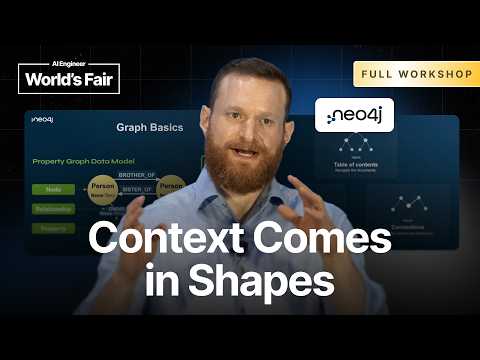
Zach Blumenfeld argues that agents fail on lakehouse data not because of model quality or query syntax, but because they lack context. Vector search retrieves a slice and Text2SQL retrieves a column, but neither tells the agent what is relevant or how pieces connect. He presents a workshop building three reusable graph shapes on top of lakehouse data using Neo4j, each answering a question an agent cannot ask a table.
The first shape is trees, which give a table of contents for the data. This lets the agent navigate what is even available — schema, shared terms, and join paths — before trying to answer a query. The containment tree links records to their parent structures, so the agent can walk the hierarchy rather than guessing which table holds the answer.
The second shape is communities, surfaced via Leiden community detection on the graph. These reveal themes the data was never explicitly tagged with: patterns nobody named but that emerge from how records connect. Hierarchical communities let the agent understand coarse and fine-grained groupings.
The third shape is paths and cycles, which trace actual relationships between entities, documents, and records. Instead of a flat join, the agent sees how things connect across the data — including indirect links and cycles that would be invisible in a query result.
These shapes are portable across BigQuery, Databricks, or Snowflake. Blumenfeld serves the graph to the agent over MCP (Model Context Protocol), so the agent consumes structure rather than writing queries blind. The workshop includes live code and a setup using Codespaces and Neo4j, and runs through Q&A on naming conventions and real-time linking at the end.
Zach Blumenfeld argues that agents fail on lakehouse data not because of model quality or query syntax, but because they lack context. Vector search retrieves a slice and Text2SQL retrieves a column, but neither tells the agent what is relevant or how pieces connect. He presents a workshop building three reusable graph shapes on top of lakehouse data using Neo4j, each answering a question an agent cannot ask a table.
The first shape is trees, which give a table of contents for the data. This lets the agent navigate what is even available — schema, shared terms, and join paths — before trying to answer a query. The containment tree links records to their parent structures, so the agent can walk the hierarchy rather than guessing which table holds the answer.
The second shape is communities, surfaced via Leiden community detection on the graph. These reveal themes the data was never explicitly tagged with: patterns nobody named but that emerge from how records connect. Hierarchical communities let the agent understand coarse and fine-grained groupings.
The third shape is paths and cycles, which trace actual relationships between entities, documents, and records. Instead of a flat join, the agent sees how things connect across the data — including indirect links and cycles that would be invisible in a query result.
These shapes are portable across BigQuery, Databricks, or Snowflake. Blumenfeld serves the graph to the agent over MCP (Model Context Protocol), so the agent consumes structure rather than writing queries blind. The workshop includes live code and a setup using Codespaces and Neo4j, and runs through Q&A on naming conventions and real-time linking at the end.