⭐⭐⭐⭐ 4.0
Addy Osmani‘s closing keynote argues that as AI agents automate more coding tasks, the engineer’s core value shifts from code production to accountability, judgment, and system ownership. He introduces answerability as a new engineering requirement: you must be able to explain, justify, and take responsibility for any code an agent produces on your behalf.
Osmani traces the evolution of software engineering through the lens of rebundling roles — as AI handles more implementation, engineers must own the full system context, including requirements, edge cases, and operational risks. He warns against cognitive debt and surrender, where engineers accept AI-generated code they don’t fully understand, which creates organizational bottlenecks and hidden technical debt.
A key concept is the orchestration tax: the overhead of designing, monitoring, and debugging multi-agent systems. Osmani argues that this tax is only justified when the system’s complexity is matched by a clear understanding of its boundaries. He proposes a decision-making ladder for high-agency engineers: clarify the problem, define the agent’s scope, validate outputs, and accept responsibility for the result.
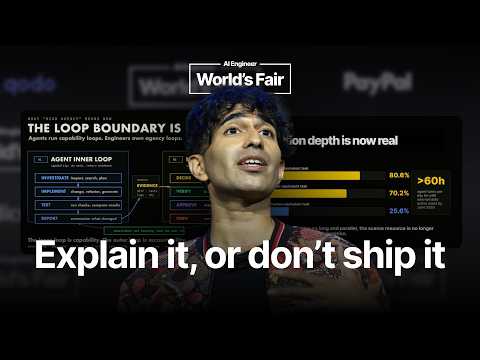
The operational rule is simple: explain it or don’t ship it. If you cannot explain how an agent’s output works, why it was chosen, and what its failure modes are, you should not deploy it. Osmani ties this to career math — credibility is earned through demonstrated judgment, not through the volume of code shipped. He concludes by predicting that this shift will unlock latent demand for software, as answerable engineers can safely scale their impact through agents without losing control of system quality.
Addy Osmani‘s closing keynote argues that as AI agents automate more coding tasks, the engineer’s core value shifts from code production to accountability, judgment, and system ownership. He introduces answerability as a new engineering requirement: you must be able to explain, justify, and take responsibility for any code an agent produces on your behalf.
Osmani traces the evolution of software engineering through the lens of rebundling roles — as AI handles more implementation, engineers must own the full system context, including requirements, edge cases, and operational risks. He warns against cognitive debt and surrender, where engineers accept AI-generated code they don’t fully understand, which creates organizational bottlenecks and hidden technical debt.
A key concept is the orchestration tax: the overhead of designing, monitoring, and debugging multi-agent systems. Osmani argues that this tax is only justified when the system’s complexity is matched by a clear understanding of its boundaries. He proposes a decision-making ladder for high-agency engineers: clarify the problem, define the agent’s scope, validate outputs, and accept responsibility for the result.
The operational rule is simple: explain it or don’t ship it. If you cannot explain how an agent’s output works, why it was chosen, and what its failure modes are, you should not deploy it. Osmani ties this to career math — credibility is earned through demonstrated judgment, not through the volume of code shipped. He concludes by predicting that this shift will unlock latent demand for software, as answerable engineers can safely scale their impact through agents without losing control of system quality.