The State of Simulation for Physical AI: An Overview
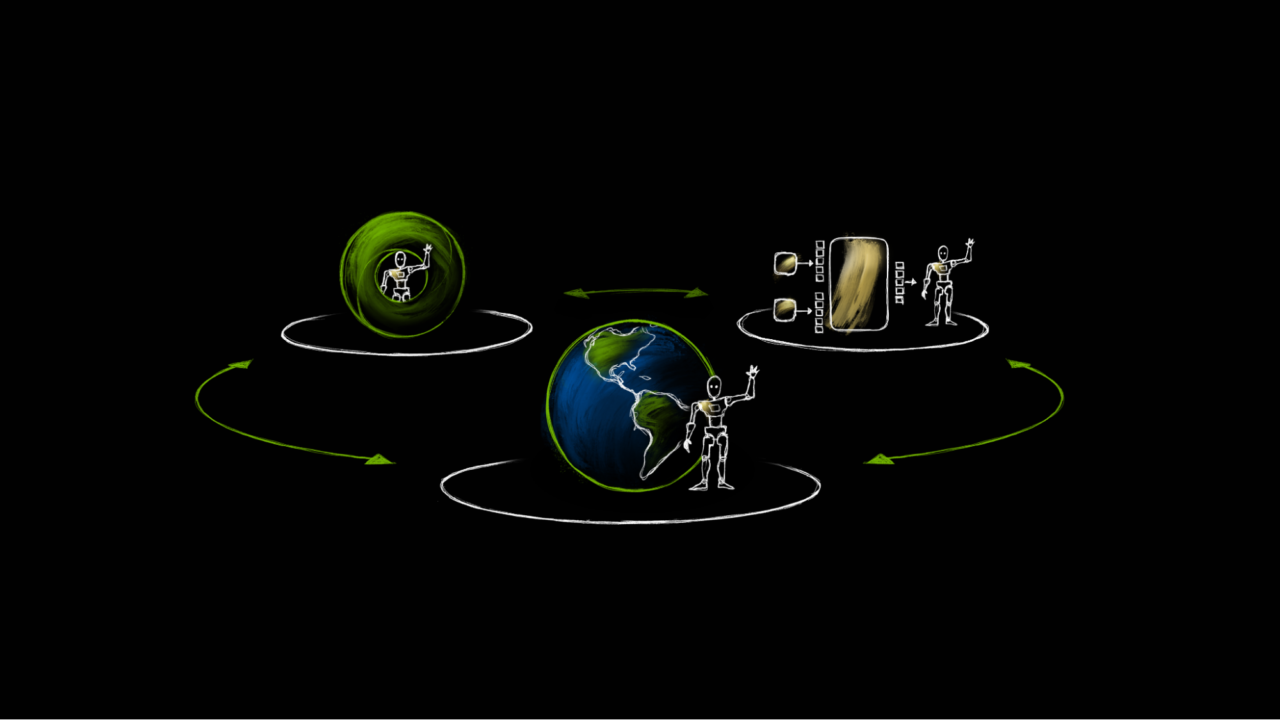
The article addresses the central challenge of building physical AI systems: data availability. Unlike LLMs and VLMs that can leverage internet-scale datasets, robotics requires physically grounded interaction data (e.g., cup slipping, cable bending, contact at wrong angles). Real-world data collection is slow, expensive, risky, and often destructive. Simulation bridges this gap by enabling developers to generate large volumes of photorealistic, physically grounded data through teleoperation and GPU-parallelized collection. The role of simulation has evolved from debugging geometry to being an integral part of the model development loop—generating perception datasets, training reinforcement learning (RL) policies, collecting demonstrations, augmenting real data, benchmarking, and testing rare or adversarial scenarios. The article frames this through a three-computer paradigm: a training computer (large GPU cluster), a simulation computer (GPU-accelerated physics and rendering), and an on-robot computer (edge device like NVIDIA Jetson AGX Thor).
A survey of popular simulation engines is provided. MuJoCo is a fast, accurate, open-source physics engine for robotics, biomechanics, and RL, emphasizing precise dynamics and contact-rich motion. It is deterministic and well-suited for model-based optimization but not for photorealistic rendering or massive GPU-parallel simulation. MuJoCo Warp (MJWarp) is a GPU-accelerated implementation in NVIDIA Warp, designed for batched simulation across many worlds, reducing CPU-GPU transfer bottlenecks and scaling contact-heavy robot tasks for RL. Isaac Sim is an open-source robotics simulation framework built on NVIDIA Omniverse with OpenUSD as its core data layer, offering high-fidelity physics (PhysX), photorealistic RTX rendering, and a wide range of sensor simulation. Isaac Lab 3.0 is an open-source, GPU-accelerated, agent-ready simulation framework for robot learning, supporting RL, imitation learning, motion planning, and data collection. Critically, Isaac Lab 3.0 decouples from Isaac Sim and Omniverse, becoming a lightweight multi-backend framework that can run on Isaac Sim with PhysX, or headless Newton physics for high-throughput simulation, with optional photorealistic sensors via OVRTX or Newton renderer.
The article introduces Newton, an open-source, GPU-accelerated, extensible, and differentiable physics engine developed by NVIDIA, Google DeepMind, and Disney Research under the Linux Foundation. Built on NVIDIA Warp and OpenUSD, Newton integrates MuJoCo Warp as a key backend. It provides multiple solver implementations—generalized-coordinate solvers (SolverMuJoCo, SolverFeatherstone), maximal-coordinate solvers (SolverSemiImplicit, SolverXPBD, SolverKamino), and specialized solvers for cloth, particles, and soft bodies (SolverVBD, SolverImplicitMPM, SolverStyle3D). The choice of solver depends on the physical system being modeled, as capabilities differ for articulations, deformable bodies, contacts, and differentiation.
Other simulation engines are briefly mentioned: PyBullet for CPU prototyping, DART and ODE as Gazebo back-ends, and Drake for contact-implicit trajectory optimization. The article concludes that robot simulation has become a foundational layer in embodied AI, where policies are stress-tested, data amplified, and training pipelines begin. The ecosystem is fragmenting into a layered stack with open-source, openly governed infrastructure (physics engines, differentiable simulators, training pipelines) accessible to anyone with a consumer GPU. The article notes a shift from asking “which engine is fastest” to “which pieces of the stack become shared infrastructure.” It previews a follow-up article focusing on Warp and MuJoCo Warp, and eventually a practical end-to-end robotics example trained on a GPU using a software stack that did not exist two years ago.