BigQuery Search innovations: Unify structured & unstructured data
Modern enterprises sit on mountains of unstructured data—PDFs, images, audio—but traditionally had to cobble together fragile pipelines: move data out of the warehouse, stitch LLM workflows, and manage separate vector indexes. The result was a fragmented architecture that rarely scaled gracefully. BigQuery‘s latest announcements directly target this tension by bringing unstructured data processing inside the warehouse, turning what was a multi-system nightmare into a single SQL-powered platform.
Three concrete features make this possible. Autonomous Embedding Generation (GA) lets you define a column in your schema, and BigQuery asynchronously generates embeddings as data arrives—no manual pipeline orchestration, retries, or error logging. You can choose external models like Vertex AI text-embeddings or natively use Gemma embedding models. It also now supports generating embeddings over images using ObjectRefs for multimodal search. AI.SEARCH (GA) provides a natural-language search function that works with the same embedding model, and for single-query agentic searches, BigQuery has observed up to a 133x gain in slot efficiency—meaning more concurrent user-facing searches without blowing up costs. Hybrid Search (Public Preview) unifies semantic vector search with lexical keyword matching, combining BM25 and Reciprocal Rank Fusion. This matters for queries like “MK3475” where pure vector search fails. You can set mode = HYBRID in AI.SEARCH and extend vector indexes with keyword columns.
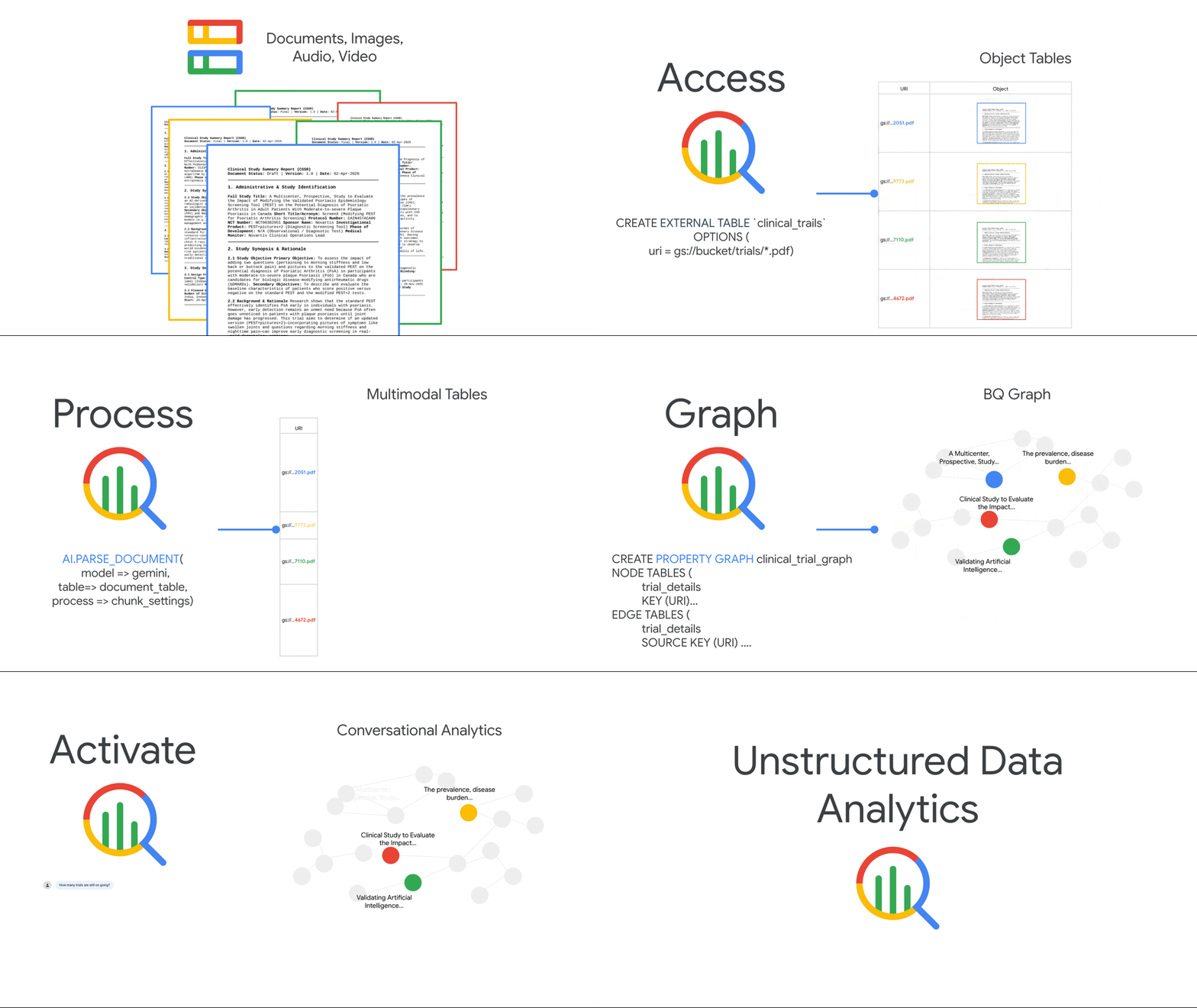
For a serious builder, the takeaway is that BigQuery is reshaping from a structured data warehouse into an end-to-end unstructured data analytics platform. The lifecycle spans Access (Object Tables for zero-ETL on PDFs in GCS), Process (AI.PARSE_DOCUMENT, AI.GENERATE, AI.CLASSIFY), Ground (autonomous embeddings + hybrid search), Relate (BigQuery Graph for entity mapping), and Activate (conversational analytics agents with AI.AGG). The operational insight is that all these capabilities live in SQL—no separate vector database, no custom embedding pipeline, no graph database. If you’re building RAG, search, or document analytics, this removes a huge amount of plumbing and gives you a single source of truth for both structured tables and raw documents. The real win is cutting the cost of LLM hallucinations through better grounding, and the 133x efficiency gain means you can actually serve natural-language agents at scale.